Bookstaken
Bookstaken
JourneyBook RecommendationsPricing
Become a Bookbuddy
JourneyBook Recommendations
Free Trial

What comes after phonics?

Your child can read the words. Next, they learn to read easily, understand what they read, talk about it and write their own.

sat

Where is your child now?

sat

Still learning letter sounds

Stay with phonics for now. Their school's programme or a phonics teacher is the right next step. Come back when blending feels easy.

Reads, but slowly

Start with stage 1: reading smoothly.

Reads well, but says little about it

Stages 2 and 3: understanding, then talking it through.

Loves reading

Stages 3 and 4: opinions of their own, then stories of their own.

Phonics is the first step, not the finish line

Phonics teaches your child to turn letters into sounds and words. Reading is what they do next.

  • Phonemic awareness

    Hearing the sounds in words

    Comes with phonics

  • sat

    Phonics

    Matching letters to sounds

    Comes with phonics

  • Fluency

    Reading smoothly

    What comes next

  • Vocabulary

    Knowing more words

    What comes next

  • Comprehension

    Understanding what they read

    What comes next

  • In the UK, children learn phonics in Reception and Year 1 and take the phonics screening check in Year 1. The government's own guidance says passing it doesn't make a child a reader yet. Through Year 2, the focus moves to fluency, new words and reading widely.
  • In India, the national NIPUN Bharat mission aims for every child to read with understanding by the end of Grade 3. Understanding is part of the goal, not an extra.
  • In the US, the National Reading Panel named five parts of learning to read. Phonics is one of them. The others are phonemic awareness, fluency, vocabulary and comprehension.

The four stages after phonics

Most children move through them in order, often working on two at once.

  1. Stage 1

    Reading smoothly

    They read without stopping at every word, so there's room left over to follow the story.

    Signs your child is here

    • Reads word by word
    • Loses the thread in long sentences
    • Tires after a page

    At home

    • Re-read a favourite book aloud
    • Take turns reading a page each
    • Read the same short passage three times, and notice how it gets easier
    When to move from picture books to chapter books
  2. Stage 2

    Reading for meaning

    They know what happened, and why.

    Signs your child is here

    • Reads aloud well, but can't say what the chapter was about
    • Skips over new words

    At home

    • At the end of a chapter, ask “What do you think happens next?”
    • Stop on one new word and talk about it
    • Ask “Why did she do that?”
    Reading comprehension classes
  3. Stage 3

    Talking about books

    They have an opinion, and a reason for it.

    Signs your child is here

    • “It was good,” and nothing more
    • Or the opposite: lots to say, and nobody to say it to

    At home

    • Ask for their verdict and one reason
    • Disagree gently, and let them defend it
    • Ask which character they'd want as a friend
    Online book discussion
  4. Stage 4

    Writing their own

    They take what they've read and make something new.

    Signs your child is here

    • Borrows characters from books they love
    • Makes up stories out loud

    At home

    • Let them write a new ending
    • Keep a notebook for story ideas
    Creative writing classes

Where a mentor helps

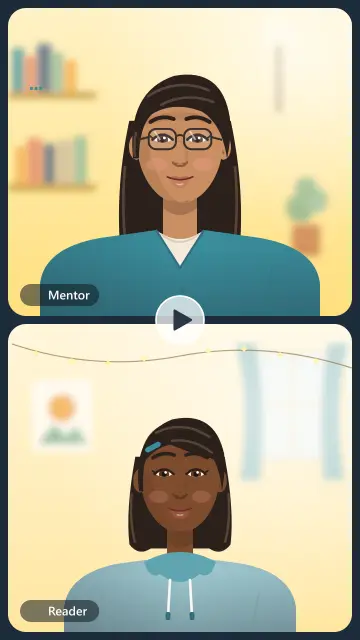
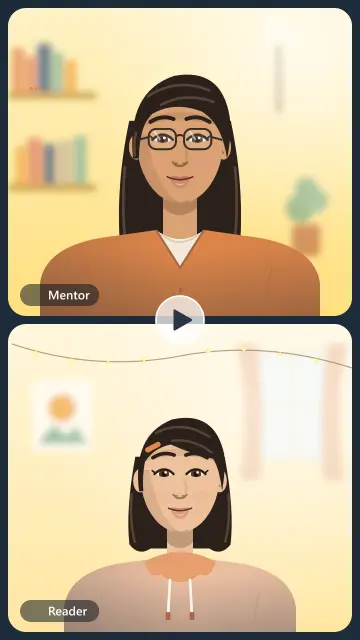
Stages 2 to 4, one book at a time. Here are two moments from real sessions: the mentor asks, and the child thinks it through out loud.

Character interview

A thoughtful idea

Bookstaken is 1:1 online reading for children aged 6–14 who can already read. A trained college mentor reads a real book picked for your child's interests with them, and talks it through. Your child gives their own verdict on the book and writes their own story, chapter by chapter. For keen readers as much as reluctant ones.

  • 60 minutes, 1:1, on Google Meet
  • A report after every session, on WhatsApp, which also tracks fluency
  • The first session's free, with no payment details
Book a Free Trial

We don't teach phonics. If your child is still learning letter sounds, a phonics teacher is the right choice.

Books for this stage

Books they can read on their own, and want to.

  • The book huntA few questions, then a book pack picked for your child.
  • Read-aloud chapter booksFirst chapter books to share, then hand over.
  • From picture books to chapter booksWhen to move up, and how to make it easy.
  • Parents' guides A–ZAges and content notes for each book.

Who the mentors are

Our mentors, called Bookbuddies, are college students from DU, the IITs, NITs, SRCC and more. They aren't certified teachers. They're close enough in age to feel like an older sibling, and that's what gets a quiet reader talking.

  • Interviewed before selection
  • Trained before assignment

Every Bookbuddy starts with an application. We screen applications, conduct interviews and provide training before assigning a mentor to a child.

Mansa

IGDTU

Soham

VNIT, Nagpur

Aditi

VNIT, Nagpur

Devyani

VNIT, Nagpur

Divya

Bharathiar University, Tamil Nadu

Thujitha

VNIT, Nagpur

Sanvi

St. Xavier's, Mumbai

Meet the Bookbuddies

Loved by Parents, Enjoyed by Kids 💛

across the world

A

Aditi

(Nagpur)

Mother of 10 years old

I've always looked for an avenue like this, wherein my children can learn from enthusiastic young students who love a subject and can instill that love in the kids ❤️❤️

9:18 AM
H

Himani

(Nagpur)

Mother of 7 years old

Thankyou so much for this report It is so thorough and well drafted Smahi is enjoying her reading session too

2:36 PM
K

Kavita

(Nagpur)

Mother of 10 years old

Thanks for such wonderful sessions and hope kids continue it 🤞 specially Oorjit....he get bore very quickly...so I always afraid to admit him for any classes 😄

6:47 PM

Frequently Asked Questions

Q: Is phonics enough for my child to become a good reader?
Phonics is the start. It teaches children to turn letters into sounds and words. The US National Reading Panel (2000) named five parts of learning to read: phonemic awareness, phonics, fluency, vocabulary and comprehension. After phonics, children still need to read smoothly, learn new words and understand what they read.
Q: When do schools stop teaching phonics?
In England, most children are taught phonics in Reception and Year 1 and take the phonics screening check in Year 1. Children who don't meet the standard take it again in Year 2. Over Year 2 and into Key Stage 2, teaching moves towards fluency, vocabulary and reading widely (Department for Education, The reading framework, 2023). In India, the NIPUN Bharat mission aims for every child to read with understanding by the end of Grade 3. In the US, it varies by state and school.
Q: My child has finished Jolly Phonics. What next?
Jolly Phonics teaches the 42 main letter sounds and how to blend them into words. Next, your child needs plenty of real books they can read with ease: re-reading favourites builds smooth reading, and talking about the story builds understanding. The four stages above show the order.
Q: How do I know if my child reads fluently enough?
England's Standards and Testing Agency says around 90 words a minute is a good sign that a child can start to focus on understanding. It also says some children understand well while reading more slowly. There's no need to time them. Listen for whether their reading sounds like talking.
Q: My child already reads well. Is there a next step?
Yes: opinions and stories of their own. Keen readers grow most when someone asks what they think and why, and when they write something of their own. That's stages 3 and 4.
Q: Does Bookstaken teach phonics?
No. We work with children who can already read. If your child is still learning letter sounds, or needs dyslexia support, a phonics teacher or a dyslexia specialist is the right choice.

Sources, checked November 2026: Department for Education, The reading framework (July 2023, updated September 2023), for the UK's phonics years, the Year 1 screening check and its Year 2 retake, the move to fluency, vocabulary and wide reading, and the Standards and Testing Agency's 90 words a minute; National Institute of Child Health and Human Development, Report of the National Reading Panel (2000), for the five parts of reading; Ministry of Education, NIPUN Bharat (July 2021), for reading with understanding by the end of Grade 3; Jolly Learning's Jolly Phonics teacher's guide, for the 42 letter sounds.

Ready for what comes after phonics? The first session's free.

60 minutes, 1:1, with a mentor matched to your child.

Book a Free Trial
Bookstaken Logo

We are building the generation that reads the fine print, questions the narrative, and writes their own future. One chapter at a time.

The Path

  • The Curriculum
  • Outcomes
  • Meet the Mentors
  • Online Reading Tutor
  • Reading Comprehension Classes
  • Creative Writing Classes
  • Communication Skills Classes
  • Book Discussions for Kids
  • Reading Tutor from India
  • Reading Tutor Cost Guide
  • What Comes After Phonics?
  • Best Online Reading Programs
  • Blogs
  • Success Stories
  • Pricing & Plans
  • Experience

Book Lists

  • Free Book Recommendations
  • Parents' Guides A–Z
  • Indian Books for Kids
  • Books for Reluctant Readers
  • Sudha Murty Books
  • Winter Break Reading Plan
  • Summer Reading Plan

The Club

  • About the Founders
  • Become a BookbuddyBecome a Bookbuddy
  • Join Parent Community

Here for You

  • Talk to a Founder
  • Parents' Guide
  • Contact Us

Privacy and Terms

  • Privacy Policy
  • Terms of Service
  • Happiness Guarantee (Refund Policy)
  • Cookie Policy

#Made with for kids

© 2026 Bookstaken Pvt. Ltd. All Rights Reserved.

Designed by Jaswanth NalluriJaswanth Nalluri

Book a free trial

🎓 Personally Matched College Mentor - Online

Books they won't put downBooks they won't put downFree list, picked just for themFree list, picked just for them
Get NowGet Now
Bookstaken