Akbar and Birbal, Tenali Rama: Clever Stories That Teach Kids to Think
Six short tales of wit retold in English, who Birbal and Tenali Rama really were, and how to pause each story so your child can work out the answer first.
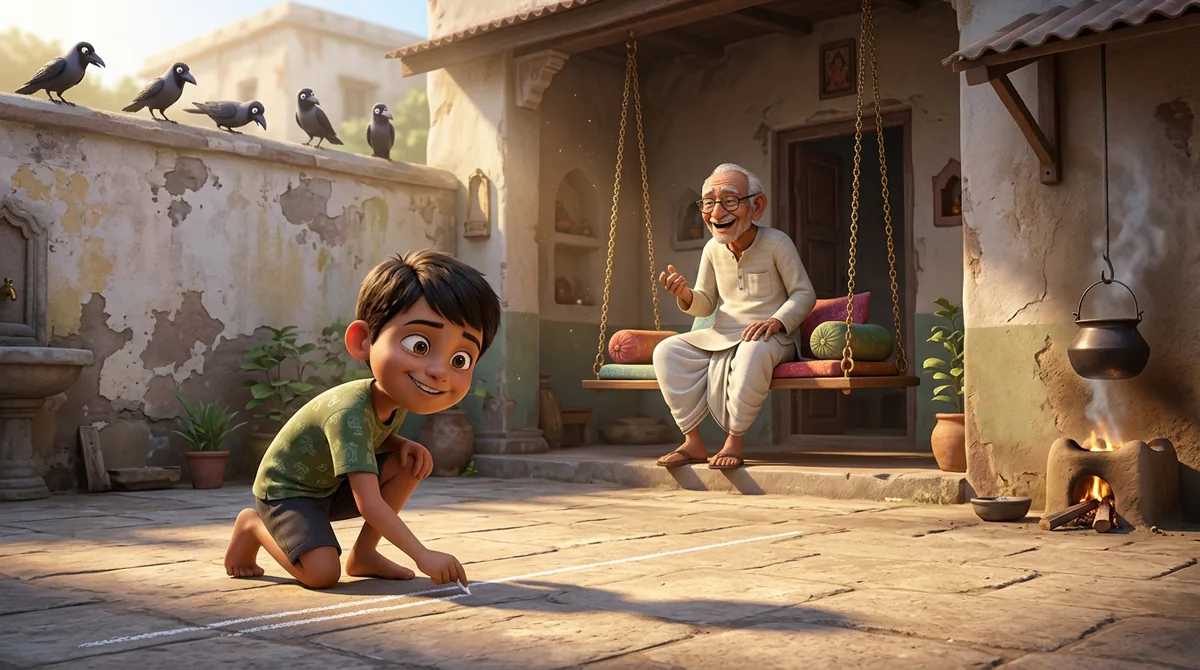
"How many crows are there in this city?" asks the emperor.
Your eight-year-old frowns. Nobody could count them all. So how did Birbal answer?
That's the joy of these stories. Each one is a puzzle: a king sets an impossible task, and a quick mind finds a way out. Stop before the answer, and your child gets to be Birbal for a minute. Here are six tales to try, and how to tell them so your child does the thinking.
In short
- Birbal and Tenali Rama were real people, remembered in hundreds of folk tales for their wit.
- Each story is a puzzle. Someone faces an impossible problem and solves it with a clever idea.
- Pause before the answer. Ask "What would you do?" and let your child try.
- Then ask how he worked it out. That's where the thinking happens.
- Children can make up their own clever-answer stories, too.
Who were Birbal and Tenali Rama?
Birbal was a real adviser and poet at the court of the Mughal emperor Akbar. Britannica gives his birth name as Mahesh Das, born in 1528, and records his death in 1586. Over the centuries, many stories of wit and quick answers grew up around him.
Tenali Rama (also called Tenali Raman or Tenali Ramakrishna) was a Telugu poet and courtier of the Vijayanagara Empire in the 16th century. Tradition places him at the court of King Krishnadevaraya. In folk tales across South India, he's the clever jester who outwits everyone, sometimes even the king.
The stories are folk tales, retold for hundreds of years, rather than records of what really happened. You'll find many versions, and some tales are told about both men.
Six clever stories, retold
For each one, read up to the pause, ask the question, and wait.
1. Counting the crows (Birbal)
One day, Emperor Akbar asked his court, "How many crows are there in this city?" Nobody knew what to say. Then Birbal stepped forward: "There are ninety-five thousand, four hundred and sixty-three crows, Your Majesty."
"And if I count them and find more?"
Pause: How could Birbal answer that?
"Then some crows are visiting from other cities," said Birbal. "And if there are fewer, some have gone to visit their relatives." Akbar laughed and let the matter rest.
Ask: Was Birbal's answer true? Why did it still work?
2. The shorter line (Birbal)
Akbar drew a line on the floor and said, "Make this line shorter, without touching it or rubbing any of it out." The courtiers stared at it, stumped.
Pause: How can you make a line shorter without touching it?
Birbal picked up the chalk and drew a longer line right beside it. Next to the new line, Akbar's line looked shorter.
Ask: Where else does something seem bigger or smaller depending on what's next to it?
3. Birbal's khichdi (Birbal)
A poor man stood all night in a freezing lake to win a reward from the emperor. But when he said he had seen a lamp burning in the palace far away, the courtiers said the lamp had kept him warm, and he was refused the reward. Soon after, Birbal invited Akbar to lunch, and kept him waiting for hours. Akbar found Birbal sitting beside a tiny fire, with a pot of khichdi hanging high above it.
Pause: What was Birbal trying to show the emperor?
"It's cooking, Your Majesty," said Birbal. "If a lamp far away can warm a man in a lake, this fire can surely cook my khichdi." Akbar understood, and gave the poor man his reward.
Ask: Why didn't Birbal just tell Akbar he was being unfair?
4. The stick that grows (Birbal)
Something precious had been stolen from a rich man's house, and one of his servants was the thief. Birbal gave every servant a stick, all exactly the same length. "By tomorrow morning," he said, "the thief's stick will have grown by a finger's width."
Pause: How will this catch the thief?
In the morning, one servant's stick was shorter than the rest. Afraid it would grow, the thief had cut a piece off in the night.
Ask: Did the stick really have magic? What did Birbal know about how people behave?
5. The thieves and the well (Tenali Rama)
One night, Tenali Rama noticed thieves hiding in his garden. He said loudly to his wife, "Our valuables will be safe if we hide them in the well." Then he went to bed.
Pause: What do you think the thieves did next? And why would Tenali want them to?
All night, the thieves hauled bucket after bucket of water out of the well, looking for treasure, and poured it on the garden. By morning they had found nothing, and Tenali's plants were watered.
Ask: Who really did the work in this story?
6. The unlucky face (Tenali Rama)
A man was said to be so unlucky that anyone who saw his face would have a bad day. The king saw him one morning, then missed his meal because of a busy day at court. Angry, the king ordered the man to be punished. Tenali Rama whispered some advice to him.
Pause: What could the man say to save himself?
"Your Majesty," said the man, "seeing my face cost you a meal. Seeing your face is costing me my freedom. So whose face is unluckier?" The king laughed and set him free.
Ask: Why did the king change his mind? Is it fair to blame someone for bad luck?
How to tell them
- Stop at the pause and wait, even if it takes a while.
- Accept any idea. "That's clever too! Here's what Birbal did."
- Ask how he worked it out. Children learn more from the how than the answer.
- Retell it the next day, with your child telling you.
These stories work well in storytelling competitions too, because each has a clear turn. See storytelling for kids.
Make up your own clever-answer story
- Think of an impossible task: "Bring me a bucket of air", "Count the stars", "Carry water in a sieve".
- Find a clever way out: a trick, a double meaning or a question back.
- Tell it with a king, a clever hero and a twist at the end.
For more thinking games, see riddles for kids and how to teach critical thinking to kids.
Hear what your child really thinks about a story
- Talks through a story
- Writes their own story
- Your report on WhatsApp
Books to read next
- Akbar and Birbal: Tales of Humour: Bookstaken's catalogue suggests 6–10.
- Birbal the Just: the catalogue suggests 8–14.
- Tenali Raman (Illustrated): the catalogue suggests 6–10.
- The Great Tenali Rama: the catalogue suggests 6–10.
- For more Indian stories, see moral stories for kids, our Amar Chitra Katha books and Indian books for kids.
By age
| Age | What works |
|---|---|
| 6–8 | Short stories read aloud with one pause, simple tricks like the shorter line |
| 9–11 | Working out the answer before the reveal, retelling stories in their own words, making up their own |
| 12–14 | Spotting how each trick works, comparing versions, writing a modern clever-answer story |
A mentor who asks "how did you work that out?"
In a Bookstaken session, your child reads a real book picked for their interests and talks it through one to one with a trained college mentor on Google Meet, with questions that ask what they think and why. Then they write a story of their own, chapter by chapter.
After every session, you get a report on WhatsApp. The first 60-minute session is free. See how it works.
Questions parents ask
What are some famous Akbar and Birbal stories?
Counting the crows, the shorter line, Birbal's khichdi and the stick that grows are among the best known. Each one has a clever answer to an impossible problem.
Who was Tenali Rama?
A 16th-century Telugu poet and courtier of the Vijayanagara Empire, traditionally placed at the court of King Krishnadevaraya. Folk tales remember him as a clever jester who outwits everyone.
Was Birbal a real person?
Yes. Birbal was an adviser and poet at Emperor Akbar's court. Britannica gives his birth name as Mahesh Das, born in 1528, and records his death in 1586. The witty stories about him are folk tales that grew up over centuries.
Why are Akbar and Birbal stories good for kids?
Each one is a puzzle. If you pause before the answer, your child gets to think through the problem, try ideas and then see a clever solution, which makes the story stick.
At what age can children read Akbar and Birbal stories?
They work as read-alouds from about 6. Bookstaken's catalogue suggests 6–10 for Akbar and Birbal: Tales of Humour, and many older children enjoy them too.
Sources
- Britannica. Birbal.
- Wikipedia: Birbal, Tenali Ramakrishna. The stories are traditional; the retellings are our own.
More guides on this topic: Focus and learning
Latest Articles
Similar Articles
Want Your Child to Experience Books More Deeply?
Bookstaken pairs kids with caring mentors who turn reading into engaging conversations, inspiring them to eventually write their own stories.
Responses
No responses yet. Be the first to share your thoughts.
Love books yourself? Get paid to read with kids as a Bookbuddy
