Storytelling for Kids: How to Tell a Story Well (at Bedtime, in Class, on Stage)
A simple shape for any story, how to use voice and pauses, bedtime stories you make up together, and getting ready for a school storytelling competition.
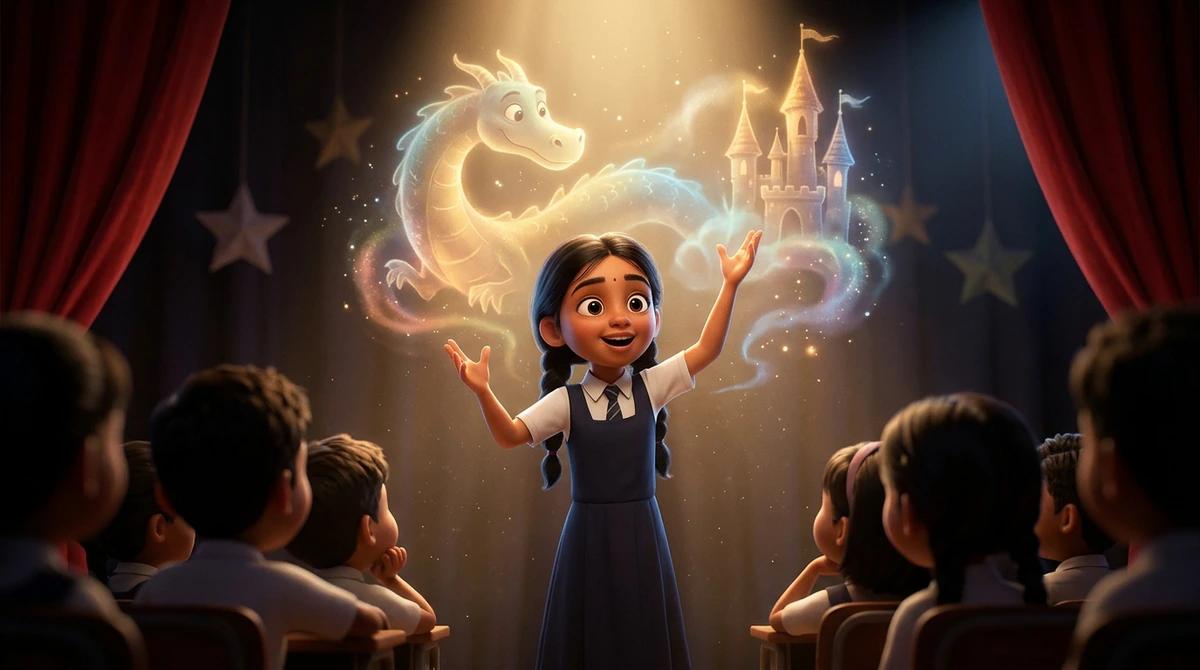
The storytelling competition is on Friday. Your eight-year-old stands in the living room, takes a deep breath and races through the whole story in forty seconds, eyes on the floor.
"Was that good?"
It was a good story. It just needs a shape, a few pauses and a voice that trusts the listener to wait. Those are skills any child can learn, at bedtime as much as on a stage. Here's how.
In short
- Every good story has a shape: a beginning, a problem, a turn and an ending.
- Telling is different from reading. Children tell a story best when they know its shape, not every word.
- Voice does the work: slow down, pause before the big moment, and give each character a sound.
- Make up stories together at bedtime, taking turns, so storytelling feels like play.
- For a competition, choose a story your child loves, check the rules, and practise it out loud on real listeners.
Why storytelling is worth practising
Telling a story asks a child to do several things at once: put events in order, choose words, keep a listener interested and land an ending. It's speaking, thinking and imagining together. It also builds the confidence to stand up and be listened to, which helps far beyond a competition. For more on that, see how to help a quiet child speak up.
A simple shape for any story
Most stories children love follow the same four steps:
| Step | What happens | Question to ask |
|---|---|---|
| Beginning | Who the story is about, and where | Who is it about? Where are they? |
| Problem | Something goes wrong, or someone wants something | What's the trouble? |
| Turn | They try to fix it, and something changes | What did they do? What happened next? |
| Ending | The problem is solved, or a lesson is learned | How does it end? How do they feel now? |
Here's a tiny example:
A monkey lived in a jamun tree by the river. A crocodile pretended to be his friend, because he wanted the monkey's heart. Halfway across the river, the crocodile told the truth. The monkey said, "My heart? I left it in the tree!" The crocodile swam back, the monkey leapt to safety, and he never rode on a crocodile again.
Four lines, four steps. A child who can tell a story in four lines can grow it to four minutes.
Telling it out loud
- Start strong. "Once there was a monkey who trusted the wrong friend" pulls listeners in faster than "This story is about a monkey."
- Slow down. Nervous tellers rush. Practise saying it at half speed.
- Pause before the big moment. A two-second silence before the twist makes everyone lean in.
- Give characters voices. A deep, slow crocodile and a quick, squeaky monkey need no costume.
- Use your face and hands, but only for the moments that matter.
- Look at the listeners, not the floor. Pick three friendly faces and take turns.
- Repeat a line. A phrase that comes back ("Snap went the crocodile's jaws") gives listeners something to wait for.
- Land the ending. Finish on a clear last line, pause, then smile.
Bedtime stories you make up together
Bedtime is the easiest place to practise, because nobody is judging.
- Take turns. You say one sentence, they say the next. Keep going until someone reaches an ending.
- Three random things. Pick three objects from the room ("a torch, a slipper and a mango") and make one story that uses all of them.
- "And then... but... so..." Use these three words to move a story along. "And then the dragon sneezed. But the sneeze was made of ice. So..."
- Let them choose the hero: a cousin, the cat, a talking auto-rickshaw.
- Bring back a favourite. Children love a character who returns night after night with a new problem.
If your child likes writing too, a story told at bedtime can become a story written the next day. Our story ideas for kids has starters to try.
Want a mentor to help with this?
- Talks through a story
- Writes their own story
- Your report on WhatsApp
Getting ready for a storytelling competition
- Read the rules first. Check the time limit, the language, whether props or costumes are allowed, and whether the story must be original.
- Choose a story your child loves. Enthusiasm shows. Fables and folk tales work well because they're short and have a clear turn: try moral stories for kids or Akbar–Birbal and Tenali Rama stories.
- Learn the shape, not every word. Write the four steps on a card. Memorising word for word makes children panic if they lose a line.
- Time it. Use a phone timer, and leave a little room for pauses and laughter.
- Practise on real listeners: grandparents on a video call, a sibling, the family at dinner.
- Record it once, then watch it together and pick one thing to improve. Just one.
- Plan for nerves. A slow breath before starting, and a first line they know by heart, help a nervous teller begin.
On the day, remind them that the audience wants them to do well. Listeners are on the teller's side.
By age
| Age | What helps |
|---|---|
| 6–8 | Retelling a favourite picture book or fable, taking turns at bedtime, simple voices for characters |
| 9–11 | Using the four-step shape, adding pauses and a strong opening line, folk tales for competitions |
| 12–14 | Telling their own stories, playing with suspense and humour, performing for a real audience |
Stories in every session
In a Bookstaken session, your child reads a real book picked for their interests and talks it through one to one with a trained college mentor on Google Meet. The free first session includes storytelling and writing, as well as talking through a story. Your child then writes a story of their own, chapter by chapter, kept in their digital story journal.
After every session, you get a report on WhatsApp. The first 60-minute session is free, and you're welcome to sit in. See how it works.
Questions parents ask
How do I teach my child storytelling?
Start with a simple shape: a beginning, a problem, a turn and an ending. Let them retell a story they know well, then practise telling it out loud with pauses and voices. Making up stories together at bedtime is the easiest way to practise.
What is a good story for a storytelling competition?
A short story your child loves, with a clear problem and a satisfying turn. Fables, folk tales and stories like Akbar and Birbal work well. Check the rules first, as some competitions ask for an original story.
How long should a story be for a school competition?
It depends on the rules, so check the time limit and practise with a timer. Leave a little room for pauses, because a story told slowly almost always lands better than one rushed to fit.
How can I make up a bedtime story with my child?
Take turns adding one sentence each, or choose three random objects and build a story around them. Let your child pick the hero, and bring back favourite characters for new adventures.
My child freezes when telling a story in front of others. What helps?
Practise in front of friendly listeners first, learn the shape rather than every word, and have a first line ready by heart. A slow breath before starting helps too.
More guides on this topic: Focus and learning
Latest Articles
Similar Articles
Want Your Child to Experience Books More Deeply?
Bookstaken pairs kids with caring mentors who turn reading into engaging conversations, inspiring them to eventually write their own stories.
Responses
No responses yet. Be the first to share your thoughts.
Love books yourself? Get paid to read with kids as a Bookbuddy
