How to Help a Quiet Child Speak Up (in Class and at Home)
Quiet, anxious or not ready yet: how to tell the difference, eight steps that help, and 15 easy topics to practise with.
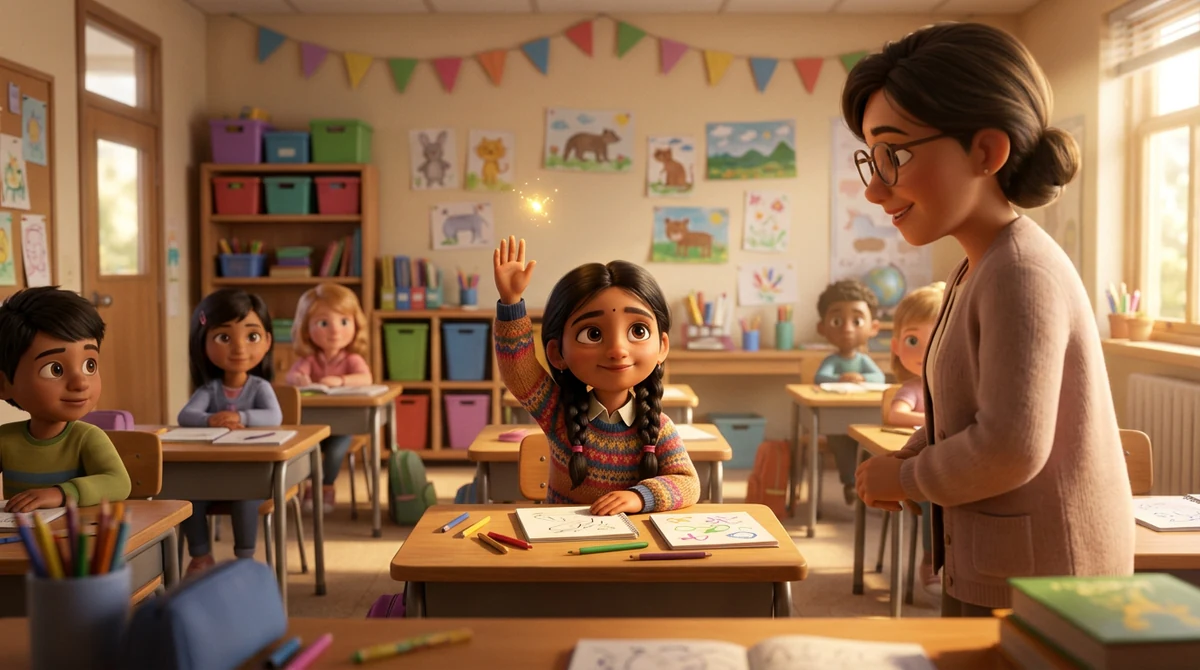
At the parent-teacher meeting, the teacher smiles. "She's a lovely girl, and her work is good. She just never puts her hand up."
You nod, a little puzzled. At home, the same child talks all through dinner about her friends, her drawings and a very long dream about a talking goat.
It can feel like two different children. It isn't. Plenty of children are chatty where they feel safe and quiet where they don't. The goal isn't to turn them into the loudest voice in the room. It's to make sure they can speak when they want to, or need to.
In short
- Quiet isn't a flaw. Many quiet children listen closely and think before they speak.
- Work out which kind of quiet it is: quiet by nature, shy and anxious, not ready yet, or, rarely, selective mutism.
- Rehearse at home, give thinking time and set tiny goals, like two sentences in class.
- Work with the teacher. A prepared question and a heads-up before being asked make a big difference.
- Praise the attempt, not the performance.


Quiet is not a problem to fix
Quiet children are often the ones who notice what others miss. They tend to think before speaking and listen well, which are real strengths.
What you want to change isn't their temperament, but any fear that stops them speaking when it matters: asking for help, sharing an idea they're proud of, or telling a friend "no". Try not to call them "shy" in front of others. Labels stick, and children often live up to them.
Which kind of quiet?
| Kind of quiet | What you might notice | What helps |
|---|---|---|
| Quiet by nature | Talks happily one to one, prefers listening in groups, isn't upset by it | Respect it; offer small chances to speak; show you value their ideas |
| Shy or anxious | Wants to join in but worries about getting it wrong or being laughed at; may blush or freeze | Rehearsing, small steps, warming up, praise for trying |
| Not ready yet | Unsure of the topic or the words, for example when learning in a second language | Preparing the topic and key words ahead; time to plan an answer |
| Selective mutism (rare) | Talks freely at home but can't speak at all in certain places, such as school | Specialist support and no pressure to speak (see "When to get help") |
What not to do
- Don't answer for them. Wait, even when the silence feels long.
- Don't push them on stage as a cure. A big, scary moment usually makes the fear bigger.
- Don't bribe or pressure them to speak. It raises the stakes.
- Don't compare them with a talkative sibling or cousin.
Eight steps that help
1. Rehearse at home
Practise the moments that feel hard: show-and-tell, answering a question in class, asking the teacher to repeat something. Say it once to you, then once to a grandparent or a sibling. Familiar words are easier to say under pressure.
2. Give thinking time
Many quiet children need a few seconds to find their answer, and someone else fills the gap first. At home, count to five in your head before helping. "Take your time" is one of the kindest things you can say.
3. Set a two-sentence goal
Big goals ("speak up more") feel impossible. Small ones feel doable: "Today, try saying two sentences in class." Ask about it after school, and celebrate any attempt.
4. Start with small audiences
Build up step by step: you, then a grandparent, then one friend, then a small group. Each step makes the next one less scary.
5. Start from what they know
Children speak most easily about what they love: dinosaurs, cricket, a favourite book. Encourage them to share their expert topic first, at home and with the teacher's help in class.
6. Prepare a question
Help your child prepare one question or answer for a lesson. With the teacher's agreement, they can give a small signal when they're ready, and the teacher calls on them then, not by surprise.
7. Role-play the hard moments
Act out the situations they find difficult: asking to join a game, ordering food, telling the teacher they don't understand. Swap roles, so they get to play the teacher too.
8. Praise the attempt
"You put your hand up today. How did that feel?" matters more than "What a great answer." It tells them that trying is what counts.
Working with the teacher
Teachers can do a lot once they know what helps.
- Share what you see at home. "She's chatty with us, but worries about getting answers wrong" gives the teacher a clear picture.
- Ask for a heads-up. Telling your child the question before asking them in front of the class gives them time to prepare.
- Agree a signal, such as a thumbs-up, that means "I have an answer."
- Pair them with a kind partner for group work.
- Set one small goal together, and check in after a few weeks.
Help them find their voice
- Talks through a story
- Writes their own story
- Your report on WhatsApp
15 easy speaking topics to practise
Pick one and ask your child to talk about it for a minute, to you first, then to someone else.
- My favourite animal, and why
- The best day I've ever had
- A book I'd recommend to a friend
- How to make my favourite snack
- If I could have any pet
- My favourite game, and how to play it
- A place I'd love to visit
- Something I'm good at
- The funniest thing that's ever happened to me
- A book character I'd swap places with
- Three things I'd take to a desert island
- My dream job
- A rule I'd change at school
- Something I've made
- What I'd do with a day off school
When to get help
Most quiet children just need time and practice. But the NHS describes selective mutism as an anxiety disorder in which a child is unable to speak in certain situations, such as with classmates at school, while speaking freely with close family when nobody else is around. It isn't refusing; they literally can't. It usually starts between the ages of 2 and 4, and is often noticed when a child starts nursery or school.
The NHS advises parents not to pressurise or bribe the child to speak, and to see a GP, who can refer them to a specialist; you can also contact a speech and language therapy service. Don't accept that your child will simply grow out of it.
Talk to their teacher or your doctor, too, if quietness comes with sadness, a reluctance to go to school or a sudden change in your child. If quietness also makes friendships hard, our guides to helping a shy child make friends and helping a lonely child can help.
By age
| Age | What helps |
|---|---|
| 6–8 | Rehearsing show-and-tell, puppets and pretend play, speaking through games |
| 9–11 | Prepared questions, small group roles, sharing an expert topic |
| 12–14 | Respecting their privacy, writing ideas down before speaking, clubs built around their interests |
An hour where theirs is the only voice that matters
Many quiet children say far more one to one. In a Bookstaken session, your child reads a real book picked for their interests and talks it through one to one with a trained college mentor on Google Meet. There's no class to talk over them, nobody to answer first, and time to think. At the Review stop, they give their own verdict on the book and explain it. Then they write a story of their own, chapter by chapter.
You're welcome to sit in on the first session, and after every session you get a report on WhatsApp. The first 60-minute session is free. See how it works.
Questions parents ask
How can I help my shy child speak up in class?
Rehearse what they'll say at home, set a small goal such as two sentences a day, and ask the teacher to give a heads-up before calling on them. Praise every attempt, not just good answers.
Is it normal for a child to be quiet at school but talkative at home?
Often, yes. Many children are chatty where they feel safe and quiet in big groups. If your child can't speak at all in certain places, such as school, over a long period, talk to your GP about selective mutism.
What is selective mutism?
The NHS describes it as an anxiety disorder in which a child is unable to speak in certain situations, such as at school, while speaking freely with close family. It usually starts between 2 and 4. A GP can refer your child for specialist support.
Should I make my shy child do public speaking?
Not as a cure. Being pushed onto a stage often makes fear bigger. Build up in small steps instead: one person, then a few, then a small group, with plenty of practice at home.
What are easy speaking topics for kids?
Topics they know well work best: a favourite animal, the best day they've had, how to play their favourite game, a book they'd recommend, or a rule they'd change at school.
Sources
- NHS (2023). Selective mutism.
More guides on this topic: Feelings and friendships
Latest Articles
Similar Articles
Want Your Child to Experience Books More Deeply?
Bookstaken pairs kids with caring mentors who turn reading into engaging conversations, inspiring them to eventually write their own stories.
Responses
No responses yet. Be the first to share your thoughts.
Love books yourself? Get paid to read with kids as a Bookbuddy
