Are Scary Books Good for Kids? What a Safe Fright Does, and Where to Start
Why some children love being scared by a story, the difference between scary and disturbing, starting points by age with named sources, and when to put a book down.
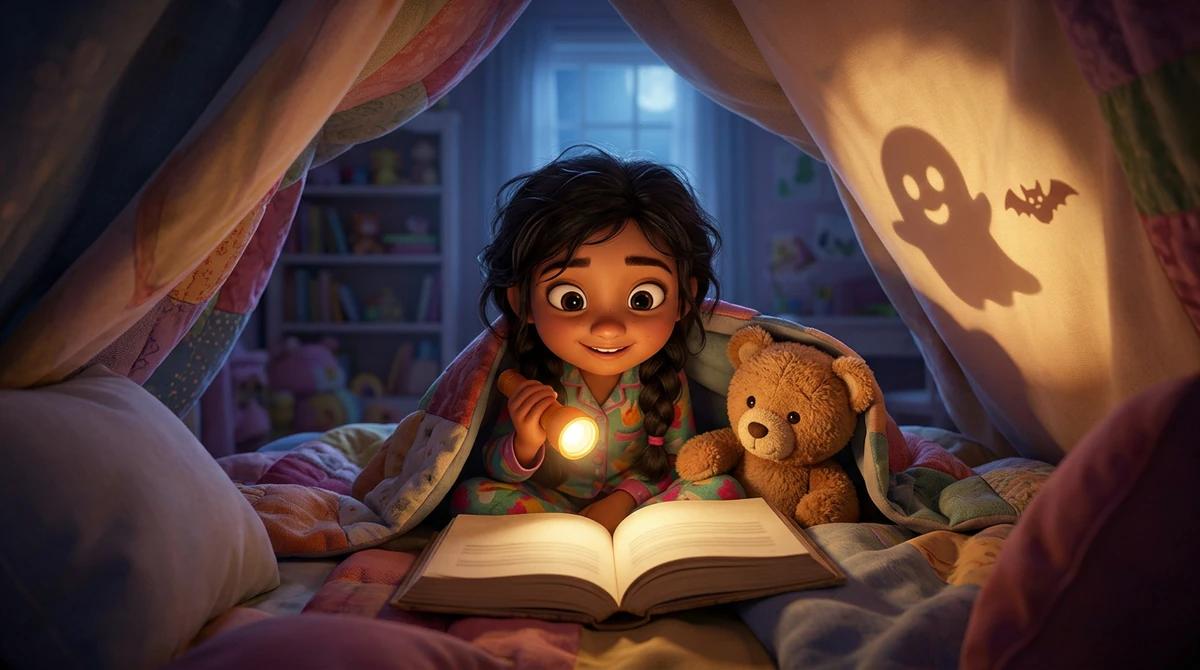
It's past bedtime, and there's a torch on under the blanket. Your nine-year-old is deep in a Goosebumps book, eyes wide.
The next night, they ask you to leave the landing light on. Then they reach for the next one in the series.
Should you worry? Usually not. For many children, a scary story is one of the most exciting things a book can do. The trick is knowing the difference between a good fright and a bad one, and finding the right book for your child.
In short
- For many children, yes. A scary book lets them feel fear somewhere safe, and they can close it whenever they like.
- There's a "just right" amount of fear. In a study at a haunted house, enjoyment rose with fear up to a point, then fell (Andersen and colleagues, 2020).
- Scary isn't the same as disturbing. Ghosts and monsters are one thing; realistic cruelty is another.
- Start with funny-scary books, such as Goosebumps, which Reading Is Fundamental lists for ages 8 to 12.
- Stop if fear spreads into the day, or nightmares go on for more than a few nights.
Why some children love a fright
- They're in control. A child can stop reading, turn the light on or skip a page. A scary dream offers no such way out.
- They get to be brave. Finishing a frightening chapter feels like an achievement.
- The ending brings relief. Most scary books for children end with the danger over and the hero safe.
- It's social. Scary stories are made for swapping, retelling and daring friends to read.
Researchers at Aarhus University in Denmark studied 110 visitors, aged 12 to 57, at a haunted-house attraction. Visitors enjoyed it most when they were moderately scared: too little fear was dull, and too much stopped being fun (Andersen and colleagues, 2020). The study wasn't about books or young children, but the idea fits: the best scary book is scary enough, and no more.
Scary or disturbing?
| Usually fine for a child who enjoys it | Worth reading yourself first |
|---|---|
| Ghosts, monsters, witches, haunted houses | Realistic violence described in detail |
| Danger that the hero escapes | Cruelty to children or animals, dwelt on |
| A creepy mood, strange noises, a twist | A hopeless ending, with no one safe |
| Jokes mixed in with the frights | Fears close to real life, such as illness or a family member in danger, for a child going through it |
The first column is a thrill. The second can stay with a child long after the book is closed. It doesn't always mean "never", but it does mean "check first, and talk about it". For how, see how to talk with your child about hard scenes in books.
Where to start, by age
| Age | Try | What the sources say |
|---|---|---|
| 6–8 | Funny, spooky picture books and short chapter books, read aloud by you | Choose ones where the monster turns out to be silly, or the ending is cosy |
| 8–12 | Goosebumps by R. L. Stine | Reading Is Fundamental lists Welcome to Dead House for ages 8 to 12. Scary, but rarely too serious |
| 8–12 | Coraline by Neil Gaiman | Reading Is Fundamental lists it for ages 8 to 12. Creepier, with a brave heroine and a clear ending |
| 9+ | The Witches by Roald Dahl | BookTrust gives an interest and reading age of 9+. Funny and frightening at once |
| 9–12 | The Graveyard Book by Neil Gaiman | Bookstaken's catalogue suggests 8–12. It won the Newbery Medal (2009) and the Carnegie Medal (2010). It opens with the killing of a family, told quietly, so read the first chapter yourself |
| 12–14 | Scary Stories to Tell in the Dark | The catalogue suggests 12–14. Short folk tales, known for their unsettling pictures |
Point Horror, the Scholastic series from the 1990s, was written for teenagers, an older audience than Goosebumps. We couldn't find an official age band for it, so read the back cover and the first chapter before you hand it over.
For more, see our mystery books for kids, many of which have a shiver without the horror, and Roald Dahl books by age.
How to share a scary book
- Read the first chapter yourself, or read it together.
- Read in daylight if bedtime is when the fear grows.
- Stop at a safe place, not on a cliffhanger, if your child is nervous.
- Talk about how it's made: "How did the author make that bit so creepy?" Looking at the tricks takes away some of the fear.
- Separate real from made up. "Could this happen? What's the author pretending?"
- Let them stop without shame. "Let's save it for next year" is a fine answer.
- Finish on something calm, like a funny book or a chat about the day.
Not sure a book is right for them? A Bookbuddy can help you choose.
- Talks through a story
- Writes their own story
- Your report on WhatsApp
When to put the book down
- Nightmares that go on for more than a few nights
- Not wanting to be alone in a room, or to go to sleep
- Worry during the day about something from the book
- Fear about real events, after a book that felt too close to real life
- A child going through a loss or a frightening time, for whom a story about the same thing may be too much
Most of these fade quickly once the book is put away. If fear or poor sleep lasts for weeks, talk to your child's doctor or school counsellor.
Every child is different
Some children love a fright; others hate it, and both are completely normal. A child who doesn't like scary books isn't timid, and a child who devours them isn't in danger. Follow your child's lead, and keep the conversation going. For more on checking a book before your child reads it, see how to check if a book is age-appropriate.
Talking through the scary parts
In a Bookstaken session, your child reads a real book picked for their interests and talks it through one to one with a trained college mentor on Google Meet: what happened, why it felt scary and what they think of it. They give their own verdict on the book, then write a story of their own, chapter by chapter.
After every session, you get a report on WhatsApp. The first 60-minute session is free, and you're welcome to sit in. See how it works.
Questions parents ask
Are scary books bad for kids?
Not usually. Many children enjoy a safe fright and feel braver for finishing a scary story. The key is matching the book to your child: funny-scary books first, realistic violence and cruelty much later, and stopping if fear spreads into everyday life.
What age is Goosebumps for?
Reading Is Fundamental lists the first book, Welcome to Dead House, for ages 8 to 12. The series is scary but light, with twists and jokes, which makes it a common first horror series.
What age are Point Horror books for?
We couldn't find an official age band from Scholastic. The series was written for teenagers, an older audience than Goosebumps, so check the back cover and read the first chapter before handing one to a younger child.
My child has nightmares after a scary book. What should I do?
Put the book away for now, without fuss, and talk about what frightened them. Read something calm or funny at bedtime instead. Most nightmares fade within days. If they last for weeks, talk to your child's doctor.
Why do kids like scary stories?
They get to feel fear while staying safe, and to be brave by finishing the story. The relief at the end feels good, and scary stories are fun to share with friends.
Sources
- Andersen, M. M., Schjoedt, U., Price, H., Rosas, F. E., Scrivner, C. and Clasen, M. (2020). Playing with fear: a field study in recreational horror. Psychological Science, 31(12).
- Reading Is Fundamental. Classic Goosebumps: Welcome to Dead House: ages 8–12.
- Reading Is Fundamental. Coraline: ages 8–12.
- BookTrust. The Witches: interest and reading age 9+.
- American Library Association. Newbery Medal winners and Honor books, 1922 to the present.
- The Carnegies. Medal for Writing winners.
- Wikipedia. Point Horror.
More guides on this topic: Reading habits and confidence
Latest Articles
Similar Articles
Want Your Child to Experience Books More Deeply?
Bookstaken pairs kids with caring mentors who turn reading into engaging conversations, inspiring them to eventually write their own stories.
Responses
No responses yet. Be the first to share your thoughts.
Love books yourself? Get paid to read with kids as a Bookbuddy
