Books for Kids Who Love Video Games: How to Get a Gamer Reading
What games already teach about stories, what a survey of young gamers found, game-tie-in books as a bridge, and series with quests, levels and worlds to explore.
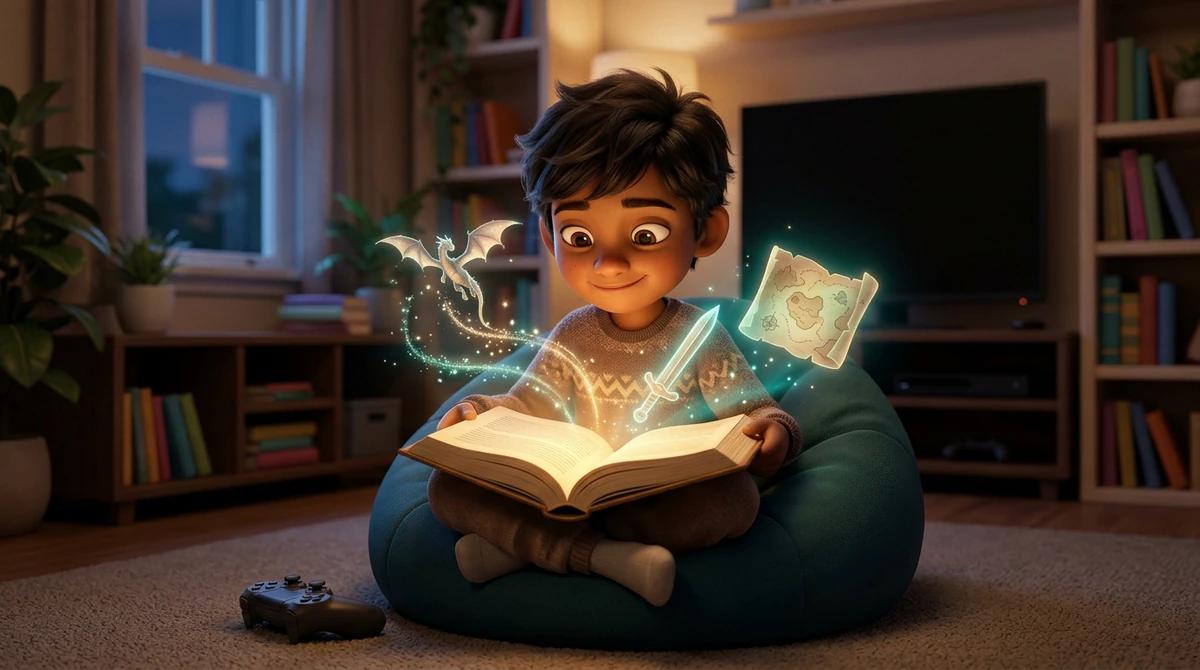
"Five more minutes. I'm about to beat the boss."
Your ten-year-old can explain every creature, weapon and secret level in their favourite game. They'll talk about it for an hour. But hand them a book, and it's "boring".
Here's the good news: a child who loves games already loves stories, worlds and characters. The trick is finding books that feel like the games they love, and not treating reading as the punishment for playing.
In short
- Many young gamers already read. In a UK survey, 79.4% of young people who play video games read something about games at least once a month (National Literacy Trust, 2020).
- Games and books share a lot: quests, levels, heroes you root for and worlds with their own rules.
- Game-tie-in books are a good bridge, such as Diary of a Minecraft Zombie.
- Then move to series with a quest, such as Wings of Fire, Percy Jackson or The Last Kids on Earth.
- Don't set books against games. Using reading as the price of screen time tends to make reading feel like a chore.
What young gamers already read
In 2019, the National Literacy Trust surveyed 4,626 young people aged 11 to 16 across the UK about video games and reading. Among those who play:
- 79.4% read materials about video games at least once a month, from in-game chat to reviews and blogs;
- 30.5% read longer pieces, such as game reviews and blogs, and 21.8% read books related to games;
- 39.5% said games make them want to read to find out more;
- 35.3% believe playing video games helps them be a better reader;
- 59.5% feel more immersed in a story in a game than in a book, rising to 73.1% of those who don't enjoy reading.
That last figure matters. For many gamers, the story isn't the problem; the page is. The answer is books that pull them in as fast as a game does.
What games and books have in common
| In a game | In a book |
|---|---|
| A quest or mission | A plot with a clear goal |
| Levels that get harder | Chapters that raise the stakes |
| A character you play | A hero you follow from inside their head |
| The boss fight | The big moment near the end |
| Lore and a map | A fantasy world with its own rules and history |
| Saving your progress | Stopping at the end of a chapter |
Point these out. "This book is basically a quest with five levels" can sound a lot more appealing than "It's a classic".
Books for every kind of gamer
If they love Minecraft or building games: Diary of a Minecraft Zombie is funny and quick, and set in a world they already know. Reading Is Fundamental lists the first book for ages 6 to 12.
If they love puzzles and escape rooms: Escape from Mr. Lemoncello's Library by Chris Grabenstein locks a group of children in a library full of puzzles they must solve to get out. Penguin Random House lists it for ages 8 to 12.
If they love battle and survival games: The Last Kids on Earth follows a boy and his friends fighting monsters after the end of the world, with lots of pictures. Bookstaken's catalogue suggests 8–12.
If they love creature and clan games: Wings of Fire is about young dragons from rival tribes; Scholastic lists the first book for ages 8 to 12. Warriors follows clans of wild cats; the catalogue suggests 9–14. See Warriors or Wings of Fire?
If they love quests and myths: Percy Jackson sends a boy who discovers he's the son of a Greek god on one quest after another. The catalogue suggests 9–14. For more, see books like Percy Jackson.
If they love open-world and survival games: The Wild Robot by Peter Brown is about a robot learning to survive on a wild island. Hachette lists it for ages 8 to 12.
For older gamers (12 to 14): The Hunger Games is about a deadly televised contest, with violence that's worth checking first. Scholastic lists it for ages 12 and up.
How to get a gamer reading
- Start with the game they love. Tie-in novels, official guides and game magazines all count as reading.
- Choose fast books. Short chapters, cliffhangers and pictures keep the pace close to a game's.
- Go for a series. A series works like levels: finish one, unlock the next.
- Try audiobooks for long fantasy series, alongside the printed book.
- Let them write about games. Reviews, walkthroughs and stories set in a game's world are real writing. The same survey found that 62.5% of young players write something related to games at least once a month.
- Be curious about their game. Ask about the story, the characters and the choices. It's the same kind of conversation you'd have about a book.
- Don't make books the price of game time. Rewards and trade-offs tend to make reading feel like a chore. See how to motivate children to read without rewards.
Try reading with a mentor who follows their interests
- Talks through a story
- Writes their own story
- Your report on WhatsApp
Balancing games and books
This isn't about games versus books. Most children can enjoy both. A regular, screen-free reading time, such as the last half hour before bed, gives books their own place without a fight. For more, see how much screen time is too much? and our guide to whether Roblox is safe for kids.
By age
| Age | What works |
|---|---|
| 6–8 | Game-tie-in chapter books, funny illustrated books, reading the story parts of a game together |
| 9–11 | Quest series like Wings of Fire and Percy Jackson, puzzle books, writing a story set in their favourite game |
| 12–14 | Longer fantasy and dystopian series, books about how games are made, fan fiction and reviews |
A mentor who gets what they love
In a Bookstaken session, your child reads a real book picked for their interests and talks it through one to one with a trained college mentor on Google Meet. Then they write a story of their own, chapter by chapter, which goes into a digital story journal.
After every session, you get a report on WhatsApp. The first 60-minute session is free. See how it works.
Questions parents ask
What books are good for kids who love Minecraft?
Diary of a Minecraft Zombie is a funny, quick series set in the Minecraft world; Reading Is Fundamental lists the first book for ages 6 to 12. After that, try survival and building stories such as The Wild Robot or The Last Kids on Earth.
Do video games help children read?
Games can lead to reading. In a National Literacy Trust survey of 4,626 young people aged 11 to 16, 79.4% of players read something about games at least once a month, and 35.3% felt games help them be better readers. Most children still need books that hook them as fast as a game does.
How do I get my gamer child to read?
Start with books linked to the game they love, then move to fast-paced series with quests, levels and worlds to explore. Keep books and games from becoming a trade, and talk about the stories in both.
Are game books real reading?
Yes. A novel set in a game world is still a novel, and reviews, guides and walkthroughs are reading too. They're often a way into other books.
What should my child read after Diary of a Minecraft Zombie?
Try The Last Kids on Earth for monsters and survival, Escape from Mr. Lemoncello's Library for puzzles, or Wings of Fire for a big series with a world to explore.
Sources
- Picton, I., Clark, C. and Judge, T. (2020). Video game playing and literacy: a survey of young people aged 11 to 16. National Literacy Trust.
- Reading Is Fundamental. Diary of a Minecraft Zombie: A Scare of a Dare: ages 6–12.
- Penguin Random House. Escape from Mr. Lemoncello's Library: ages 8–12.
- Scholastic Canada. The Dragonet Prophecy (Wings of Fire #1): ages 8–12.
- Hachette. The Wild Robot: ages 8–12.
- Scholastic. The Hunger Games: ages 12 and up.
More guides on this topic: Screen time and tech
Latest Articles
Similar Articles
Want Your Child to Experience Books More Deeply?
Bookstaken pairs kids with caring mentors who turn reading into engaging conversations, inspiring them to eventually write their own stories.
Responses
No responses yet. Be the first to share your thoughts.
Love books yourself? Get paid to read with kids as a Bookbuddy
