Conversation Starters for Kids: Questions That Get More Than "Fine"
Why children say "fine", 40 questions sorted by the moment, and the listening moves that keep them talking.
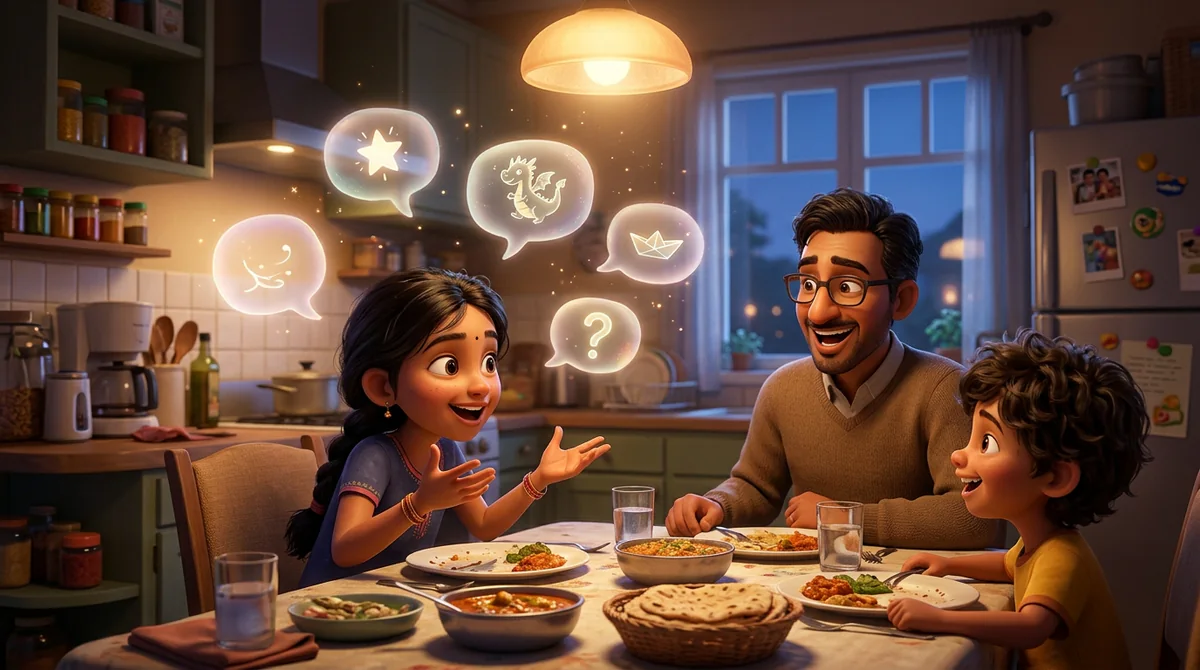
"How was school?"
"Fine."
"What did you do?"
"Nothing."
Every parent knows this conversation. Then, at quarter past nine, with the light off and your hand on the door, your child says, "Can I tell you something?" and talks for twenty minutes about a friend, a teacher and a lunchbox incident you'd never have guessed.
Children do want to talk. They just don't want to talk on our schedule, or in answer to a question that's too big to hold. The right question, at the right moment, changes everything. Here are forty, sorted by when to ask them, and the small listening habits that keep a conversation going once it starts.
In short
- Children say "fine" because of timing, tiredness or a question that's too big. "How was your day?" asks them to sum up six hours.
- Small, specific questions work better: "Who did you sit with at lunch?" gets more than "How was school?"
- Timing matters more than wording. The car, bedtime and side-by-side jobs beat a face-to-face interview.
- Listen more than you ask. Wait, reflect what they said, and ask one follow-up, not five.
- Questions about books and what-ifs are easy ways in, because there's no wrong answer.


Why children say "fine"
The timing is wrong. Straight after school, many children are drained. They've followed rules and held their feelings in all day, and the first hour home is for recovering, not reporting. If your child falls apart after school, our guide to after-school restraint collapse explains why.
The question is too big. "How was your day?" asks a child to sum up six hours of lessons, friendships, small wins and small embarrassments into one word. "Fine" is the honest summary.
It sounds like a test. "What did you learn today?" can feel like a quiz they might fail.
They want privacy. From about ten, children start keeping more to themselves. That's healthy. It means the conversations that do happen need more trust and less questioning.
Why it's worth the effort
Back-and-forth conversation does more than keep you in touch. In a study at MIT, children aged four to six who took part in more conversational turns with adults (one person speaks, the other answers) showed more activity in a key language area of the brain, regardless of how many words they heard overall (Romeo and colleagues, 2018). The children in that study were younger than ours, but the lesson travels: it's the back-and-forth that counts, not the lecture.
40 conversation starters
After school (when they're ready)
Give them a snack and some quiet first. Then try one of these, not all of them:
- What was the best part of today? And the most boring?
- Who did you sit with at lunch?
- Did anyone make you laugh today?
- Did your teacher say anything that surprised you?
- Was anyone in trouble today? (Children love this one.)
- If you could redo one moment of today, which would it be?
- What are you looking forward to tomorrow?
- Tell me one thing that happened today that I'd never guess.
At dinner (everyone answers, adults too)
- If you could invite anyone to dinner, real or from a book, who would it be?
- If you were head teacher for a day, what would you change?
- What's a rule you think is unfair? Why?
- What's the kindest thing someone did today?
- What's something you're better at than me?
- If our family had a motto, what would it be?
- What's a question you've been wondering about lately?
- Best and hardest: one good thing and one hard thing from today.
In the car (side by side, no eye contact needed)
- If you had a superpower for one day only, what would it be?
- Which friend would you want with you on a desert island? Why them?
- What's the hardest thing about being your age?
- Would you rather be able to fly or be invisible? Why?
- What do you think the person in that car is on their way to do?
- If you could live anywhere in the world for a year, where?
At bedtime (the most honest time of day)
- What made you feel proud today?
- Was there a moment today you felt left out, or worried?
- What's something you want to get better at?
- Who would you like to say thank you to?
- What do you hope you dream about?
- Is there anything you want to tell me before you sleep?
Big what-ifs (any time)
- If animals could talk, which would be the rudest?
- If you could live inside any book, which would you choose?
- If you were in charge of the world for a day, what would you do first?
- If you could ask your future self one question, what would it be?
- What would you do if you found a door in our house we'd never seen?
- If you could invent a new holiday, what would we celebrate?
About books
Books are an easy way in: talking about a character is safer than talking about yourself, and children often say what they think about their own lives through the people in stories.
- Which character would you swap places with for a day?
- Who's the most annoying character in what you're reading?
- What do you think happens next?
- Would you give this book to a friend? Which friend?
- If you could ask the author one question, what would it be?
- Which part would make the best scene in a film?
For more, sorted by age and with sample conversations, see questions to ask your child about a book.
Listening moves that keep them talking
The question opens the door. What you do next decides whether they walk through it.
- Wait. After you ask, count to five in your head. Children often need a moment to find their answer.
- Reflect, don't fix. "That sounds really annoying" keeps them talking. Advice too early usually ends the conversation.
- One follow-up, not five. "What happened next?" is enough. A string of questions turns a chat into an interview.
- Go first. At dinner, answer the question yourself before asking them. It shows the kind of answer you mean.
- Put the phone away. Children notice when you're half-listening.
- Keep their secrets. If something they share comes back later as a telling-off, or gets passed on to a relative, they'll stop sharing.
Hear what your child really thinks about a story
- Talks through a story
- Writes their own story
- Your report on WhatsApp
By age
| Age | What works |
|---|---|
| 6–8 | Concrete questions about people and things ("Who did you play with?"), silly what-ifs, and talking while you play together |
| 9–11 | Opinions and fairness ("Was that fair?"), questions about friends, and talking in the car or while cooking together |
| 12–14 | Their views on the world, side-by-side moments, short questions without follow-up pressure, and accepting "I don't want to talk about it" |
When "fine" might mean something more
Most of the time, "fine" just means tired. But if your child has stopped talking about friends altogether, seems withdrawn for weeks, or there are changes in sleep, eating or mood, it's worth a gentle conversation and a word with their teacher. If you're worried, talk to your doctor. Our guide to helping a lonely child covers what to say and what helps.
Kids say "Fine." Our reports say the rest.
In a Bookstaken session, your child talks a real book through one to one with a trained college mentor on Google Meet: what happened, what they'd have done, who they'd trust and why. Because the talking is about a story, many children open up in ways they don't when asked about their day. Then they write a story of their own, chapter by chapter.
After every session, you get a report on WhatsApp: what they read, what they talked about and how they're growing. It's for children aged 6 to 14 who can already read, and the first 60-minute session is free. See how it works.
Questions parents ask
What are good conversation starters for kids?
Small, specific questions work best: "Who did you sit with at lunch?", "What made you laugh today?", "Which character would you swap places with?" Big what-ifs, like "If you could live inside any book, which would you choose?", are easy ways in because there's no wrong answer.
How do I get my child to talk about their day?
Wait until they've had a snack and some quiet time, ask one small question instead of "How was your day?", and listen without fixing. The car and bedtime are often the easiest times, because there's less pressure.
Why does my child always say "fine"?
Usually because they're tired, or because "How was your day?" is too big a question to answer. Some children also want more privacy as they grow. Specific questions and better timing get more than "fine".
What are some deep questions to ask a child?
Try "What's something you've been wondering about lately?", "What's a rule you think is unfair?", "If you could ask your future self one question, what would it be?" and "What's the hardest thing about being your age?"
How do I talk to a 12-year-old who won't talk?
Talk side by side rather than face to face: in the car, while cooking or on a walk. Ask short questions, accept "I don't want to talk about it", and keep what they tell you private. Being available matters more than asking.
Sources
- Romeo, R. R., Leonard, J. A., Robinson, S. T., West, M. R., Mackey, A. P., Rowe, M. L., & Gabrieli, J. D. E. (2018). Beyond the 30-million-word gap: Children's conversational exposure is associated with language-related brain function. Psychological Science, 29(5), 700–710.
More guides on this topic: Feelings and friendships
Latest Articles
Similar Articles
Want Your Child to Experience Books More Deeply?
Bookstaken pairs kids with caring mentors who turn reading into engaging conversations, inspiring them to eventually write their own stories.
Responses
No responses yet. Be the first to share your thoughts.
Love books yourself? Get paid to read with kids as a Bookbuddy
