The Mahabharata for Kids: How to Introduce It, and Retellings by Age
Where to start with India's great epic, five stories children love, retellings by age with named sources, and how to talk about war and hard choices.
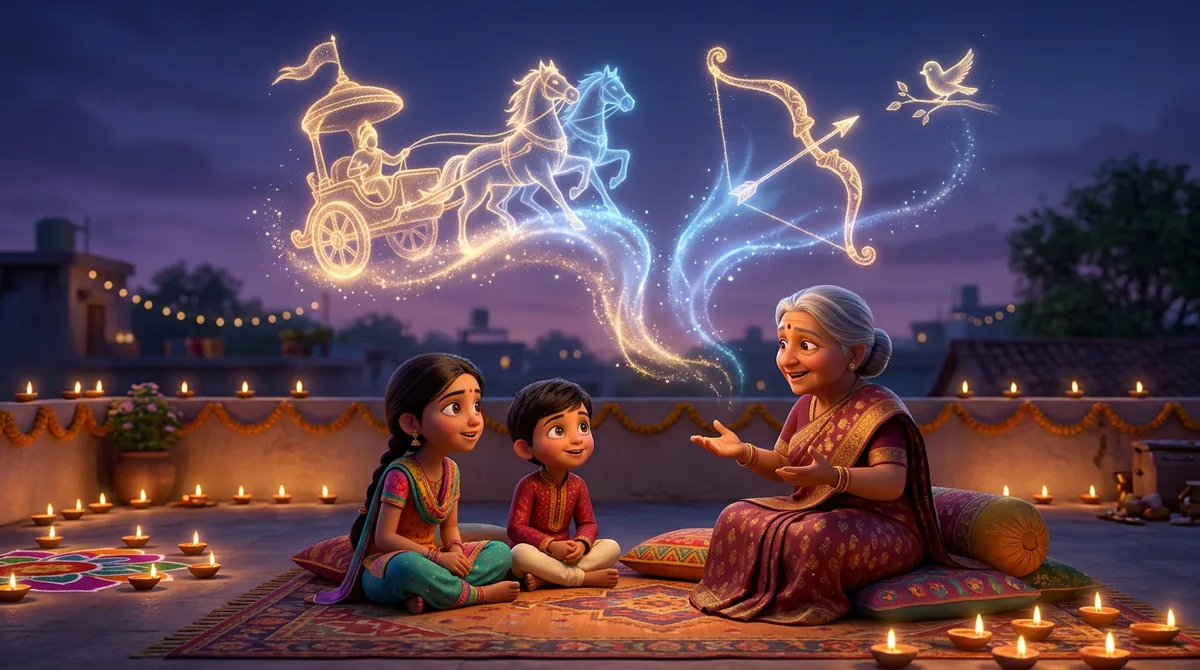
It's the Diwali holidays, and a grandparent is telling the story of Eklavya: the boy who taught himself archery, and the teacher who asked for his thumb.
Your nine-year-old sits up. "But that's not fair!"
That's the Mahabharata. It's full of heroes who make terrible mistakes, villains with good reasons and choices with no easy answer. That's exactly what makes it so good for children, once you know where to start.
In short
- Start with single stories, not the whole epic. Eklavya, Arjuna and the bird's eye, and the Yaksha's questions are good first tales.
- Ages 6 to 8: picture books and comics read aloud, one story at a time.
- Ages 8 to 11: illustrated retellings and collections of lesser-known tales.
- Ages 11 to 14: fuller retellings, and books that question the war.
- Talk about the hard choices. The Mahabharata rarely tells you who was right, which makes for great conversations.
What is the Mahabharata?
The Mahabharata is one of the two great Sanskrit epics of ancient India, alongside the Ramayana. At its heart is a family quarrel: two sets of cousins, the five Pandava brothers and the hundred Kauravas, fight over a kingdom, and it ends in the great war at Kurukshetra. The Bhagavad Gita, Krishna's conversation with Arjuna before the battle, is part of it.
It's also enormous, with hundreds of characters and stories inside stories. No child needs all of it at once.
Five stories to start with
Arjuna and the bird's eye
The teacher Drona set his students a test: shoot the eye of a wooden bird in a tree. He asked each one what they could see. "The tree, the branches, the bird," they said. Only Arjuna answered, "I see only the bird's eye." He was the one who hit it.
Talk about: What helps you concentrate? When is it hard to see only the bird's eye?
Eklavya's thumb
Eklavya wanted to learn archery from Drona, but was turned away. So he made a clay statue of Drona and practised in front of it until he was a better archer than Arjuna. When Drona found out, he asked for Eklavya's right thumb as his teacher's fee, and Eklavya gave it.
Talk about: Was Drona fair? Was Eklavya right to give his thumb? Children almost always have something to say about this one.
The Yaksha's questions
The thirsty Pandava brothers came to a lake guarded by a yaksha, a spirit, who said they could drink only if they answered his questions first. Four brothers ignored him, drank, and fell down lifeless. Yudhishthira answered every question, such as "What is faster than the wind?" ("The mind"), and the yaksha brought his brothers back.
Talk about: Make up your own riddles to test each other. See our riddles for kids.
Karna's loyalty
Karna was the eldest son of Kunti, the Pandavas' mother, but was raised by a charioteer and didn't know it for most of his life. Duryodhana, the eldest Kaurava, was the one person who treated him as an equal, so Karna stayed loyal to him, even when he learned that the Pandavas were his brothers.
Talk about: Is loyalty always good? What would you have done?
The game of dice
Yudhishthira, the eldest Pandava, played a game of dice against his cousins and couldn't stop. He gambled away his kingdom, his brothers, himself, and finally their wife Draupadi, who was then humiliated in front of the court.
Talk about: Why couldn't Yudhishthira stop? This one suits older children, and it's worth previewing how your retelling tells it.
Retellings and books by age
| Age | Try | What the sources say |
|---|---|---|
| 6–8 | Krishna (Amar Chitra Katha) and single stories read aloud | Bookstaken's catalogue suggests 6–12 for the Krishna comic |
| 8–11 | Mahabharata (Amar Chitra Katha) | The catalogue suggests 8–14. The comic format makes the huge cast easier to follow |
| 8–11 | Sudha Murty's The Serpent's Revenge: Unusual Tales from the Mahabharata | Published by Puffin in 2016. Penguin doesn't give an age band; it's a collection of lesser-known stories |
| 8–12 | Aru Shah and the End of Time | Publishers Weekly gave it ages 8–12. A modern fantasy whose heroine learns she's a reborn Pandava |
| 10–14 | Samhita Arni's The Mahabharatha: A Child's View | Tara Books says she wrote it when she was twelve. It's openly critical of the war |
| 10–14 | The Gita for Children by Roopa Pai | Hachette India gives no age band; the catalogue suggests 9–14. Retells Krishna and Arjuna's conversation |
For more, see our mythology books for kids, Amar Chitra Katha books and Ramayana books for kids.
How to talk about the war and the hard choices
The Mahabharata builds to a war in which almost everyone dies, on both sides. Children will notice that the "good" side cheats too. That's not a problem to hide; it's one of the best things about the story.
- Ask "was that fair?" about Eklavya, Karna and the dice game. Let them argue.
- Ask what each side wanted. The Kauravas had their reasons too.
- Ask what they'd have done differently. Could the war have been stopped?
- Notice that versions differ. Families, regions and books tell the stories in different ways. "Our version says this. What does yours say?" is a good question.
For more on talking through difficult parts of books, see how to talk with your child about hard scenes in books.
Give a keen reader someone to talk books with
- Talks through a story
- Writes their own story
- Your report on WhatsApp
Tips for telling it
- Draw the family tree. Five Pandavas, a hundred Kauravas, and the grandfather Bhishma at the top. Children love keeping track.
- One character at a time. A week of Arjuna stories, then a week of Bhima.
- Let grandparents tell it. Many families have their own favourite stories and ways of telling them.
- Watch for scary bits. Battles, deaths and curses run through the epic, so preview a retelling for a sensitive child.
Ramayana or Mahabharata first?
Many families start with the Ramayana, which has a clearer hero and a simpler story, then come to the Mahabharata. But single Mahabharata stories, like Arjuna and the bird's eye, work at any age.
Talking it through, one to one
In a Bookstaken session, your child reads a real book picked for their interests and talks it through one to one with a trained college mentor on Google Meet, including the questions with no easy answer. They give their own verdict on it and write a story of their own, chapter by chapter.
After every session, you get a report on WhatsApp. The first 60-minute session is free. See how it works.
Questions parents ask
At what age can kids read the Mahabharata?
Single stories read aloud work from about 6. Comic retellings such as Amar Chitra Katha suit many 8- to 11-year-olds, and fuller retellings suit confident readers from about 10. Check each book's battles and difficult scenes.
Which Mahabharata book is best for kids?
For younger children, Amar Chitra Katha comics and single stories read aloud. For 8 to 12, Sudha Murty's The Serpent's Revenge or Aru Shah and the End of Time, a modern fantasy. For older readers, Samhita Arni's The Mahabharatha: A Child's View.
How do I explain the Mahabharata to a child?
Start with one story, not the whole epic. Explain that it's about two families of cousins who quarrel over a kingdom, then tell a short tale like Arjuna and the bird's eye. Drawing the family tree helps.
Is the Mahabharata too violent for children?
It includes a great war and many deaths. Retellings for children handle this in different ways, so preview the book, start with gentler stories and talk about the war together.
Should my child read the Ramayana or the Mahabharata first?
Many families start with the Ramayana, which has a clearer hero and a simpler story. But single Mahabharata stories work well at any age.
Sources
- Wikipedia. Mahabharata.
- Tara Books. The Mahabharatha: A Child's View.
- Penguin India. The Serpent's Revenge.
- Hachette India. The Gita for Children.
- Publishers Weekly. Aru Shah and the End of Time.
More guides on this topic: Reading habits and confidence
Latest Articles
Similar Articles
Want Your Child to Experience Books More Deeply?
Bookstaken pairs kids with caring mentors who turn reading into engaging conversations, inspiring them to eventually write their own stories.
Responses
No responses yet. Be the first to share your thoughts.
Love books yourself? Get paid to read with kids as a Bookbuddy
