How to Build Confidence in Kids: What Actually Works at Home
Confidence comes from being capable and being heard. Ten everyday habits, the praise that helps, and what to say instead.
Your ten-year-old won't audition for the school play. "I'm not good at acting." Last month it was maths, and before that, the swimming gala.
You've told them a hundred times that they're brilliant. It hasn't helped, and that's the surprising part: confidence rarely comes from being told you're great. It comes from doing hard things, getting through the wobbly middle, and being taken seriously by the people who matter most.
This guide covers where confidence really comes from, what the research says about praise, and ten habits you can start this week.
In short
- Confidence has two roots: feeling capable ("I can do hard things") and feeling heard ("What I think matters").
- Praise effort and strategy, not intelligence. Children praised for being clever chose easier tasks afterwards (Mueller and Dweck, 1998).
- Skip over-the-top praise. It led children with low self-esteem to avoid challenges (Brummelman and colleagues, 2014).
- Let them fail small, and coach instead of fixing.
- Ask their opinion, and use it. Being taken seriously builds confidence as much as success does.



Where confidence comes from
Being capable. Every time a child does something that felt too hard, and manages it, they collect proof that they can. Cooking a meal, catching the right bus with a friend, finishing a long book: each one is evidence.
Being heard. A child whose ideas are listened to, and sometimes acted on, learns that their voice has weight. That's what lets them speak up in class, disagree with a friend or try out for the play.
Telling a child they're wonderful doesn't give them either. Giving them chances to be capable and heard does.
What the research says about praise
In a set of studies with fifth graders, children praised for their intelligence ("You must be smart at this") were more likely to choose easier problems next time than children praised for their effort. After a setback, the children praised for intelligence enjoyed the task less and did worse (Mueller and Dweck, 1998).
Later research looked at inflated praise, such as "That's not just beautiful, that's incredibly beautiful!" Children with low self-esteem who heard it were more likely to avoid challenges afterwards (Brummelman and colleagues, 2014). The children who seem to need the biggest boost can be the ones most set back by it.
The lesson isn't to stop praising. It's to praise what children did, honestly and specifically.
Ten habits that build confidence
1. Give them real jobs
Not pretend jobs, real ones: making a simple dinner, planning one day of a holiday, paying at the shop, looking after a younger cousin for an hour. Real responsibility tells a child you trust them.
2. Praise the process
"You kept going when it got hard" and "You tried a different way" tell a child what to do next time. "You're so clever" doesn't.
3. Keep praise honest
Children know when praise is too much. Specific, true comments ("The ending of your story made me laugh") mean more than big words.
4. Let them fail small
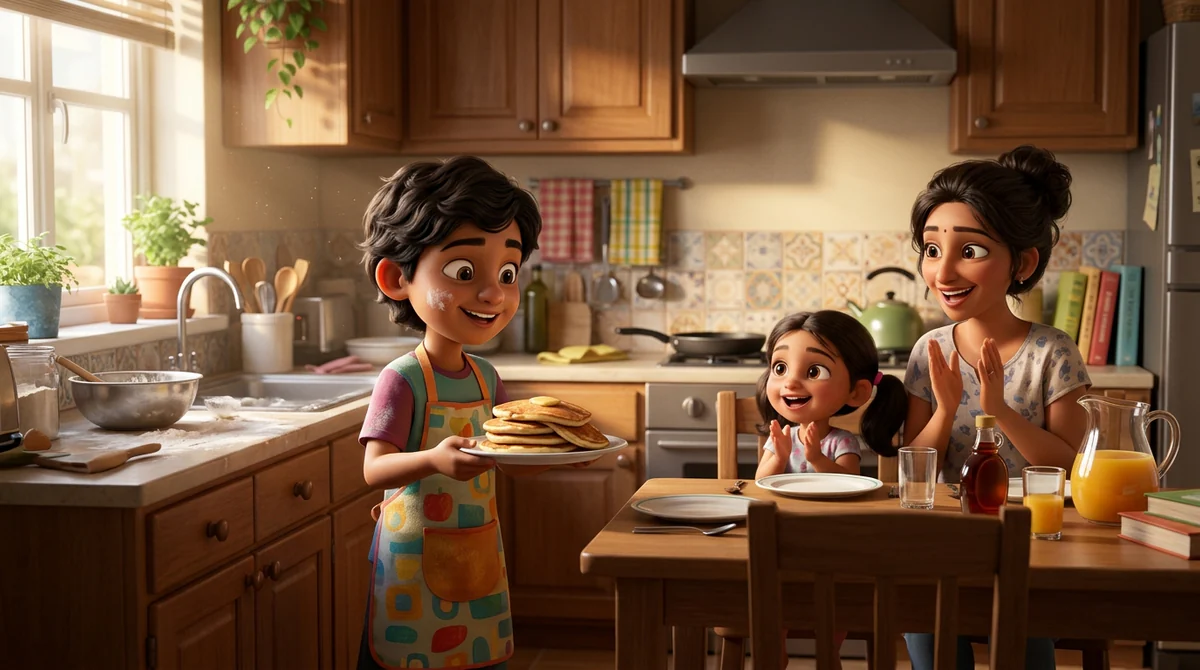
A burnt pancake, a lost game, a wobbly first draft. Small failures, with you nearby, teach a child that mistakes are survivable. Step in only when the stakes are high.
5. Coach, don't fix
When they're stuck, ask before helping: "What have you tried? What could you try next?" Solving it themselves, even slowly, builds more than having it solved for them.
6. Ask their opinion, and use it
Let them choose the weekend outing, the route to the park or what's for dinner on Friday. When their idea is used, they learn that their thinking matters.
7. Find one thing they're good at
Every child needs something that's theirs: drawing, cricket, chess, baking, knowing every dinosaur. Being good at one thing makes it easier to be a beginner at others.
8. Stop comparing
"Your cousin is already reading Harry Potter" helps nobody. Compare them only with themselves: "Six months ago, you couldn't do that."
9. Show your own mistakes
Say it out loud when you get something wrong: "I got the directions wrong. Let's work it out." Children learn that capable people make mistakes, and fix them.
10. Notice quiet wins
The friend they comforted, the message they wrote to their teacher, the time they asked a shopkeeper for help. Naming these small wins shows them confidence isn't only about big moments.
Phrases to try
| Instead of | Try |
|---|---|
| "You're so smart." | "You worked that out step by step." |
| "You're a natural!" | "All that practice is showing." |
| "That's the best drawing ever!" | "Tell me about the colours you chose." |
| "Don't worry, I'll do it." | "What's the first thing you could try?" |
| "Why can't you be more like your sister?" | "What would help you feel ready?" |
| "You're just not a maths person." | "Maths is hard right now. Which part is tricky?" |
| "Don't be nervous!" | "It's okay to feel nervous. What's one small step?" |
For more phrases like these, see our guide to growth mindset phrases for kids.
By age
| Age | What helps |
|---|---|
| 6–8 | Jobs with a clear finish, choosing between two options, praise for trying, plenty of "you did it yourself" |
| 9–11 | Bigger responsibilities, planning something for the family, small, safe risks, hobbies they own |
| 12–14 | Being taken seriously, a real say in family decisions, room to fail without a lecture, respect for their privacy |
Give your child room to share an idea
- Talks through a story
- Writes their own story
- Your report on WhatsApp
The sensitive child
Some children feel criticism deeply and worry about new situations. For them:
- Prepare ahead. Talk through what will happen at a new class or a party.
- Name the feeling. "You seem worried about tomorrow" helps them feel understood.
- Take smaller steps. Watch a session before joining in; join for ten minutes before staying the whole time.
- Value their strengths. Sensitive children often notice how others feel. Tell them that's a gift.
When confidence drops suddenly
If a confident child suddenly doubts everything, look for a cause: a change at school, a falling-out with friends or unkind comments. Talk to them gently, and to their teacher. If low confidence comes with sadness or worry that lasts for weeks, talk to your doctor. Our guide to helping a lonely child may also help.
Reading and confidence
Books give children a safe place to try being brave: they watch characters feel scared and do it anyway. And finishing a book they chose is a quiet win of its own. If reading itself is where confidence is low, see how to build reading confidence in children.
Watch their confidence grow
In a Bookstaken session, your child is both capable and heard. They read a real book picked for their interests and talk it through one to one with a trained college mentor on Google Meet. At the Review stop, they give their own verdict on the book and defend it. Then they write a story of their own, chapter by chapter, kept in their digital story journal.
It suits keen readers who want someone to think out loud with, and quieter children who need room to find their voice. After every session, you get a report on WhatsApp, so you can see how they're growing. The first 60-minute session is free. See how it works.
Questions parents ask
How can I build my child's confidence?
Give them real jobs, praise their effort and strategies rather than their intelligence, let them fail in small ways, and ask their opinion and use it. Confidence grows from being capable and being heard.
Does praise build confidence?
The right kind does. Praise for effort and specific, honest comments help. Research found that praising children for being clever made them choose easier tasks, and over-the-top praise led children with low self-esteem to avoid challenges.
How do I build confidence in a sensitive child?
Prepare them for new situations, name their feelings, break challenges into smaller steps and value their strengths, such as noticing how others feel. Avoid pushing them into big moments before they're ready.
What should I say instead of "good job"?
Say what they did: "You kept going when it was hard," "You tried a new way," or "Tell me how you did that." Specific comments tell a child what to do again.
How can I help my child not give up?
Let them struggle a little before stepping in, ask what they could try next, and praise the effort and the strategy. Share your own mistakes, so they see that getting stuck is normal.
Sources
- Brummelman, E., Thomaes, S., Orobio de Castro, B., Overbeek, G., & Bushman, B. J. (2014). "That's not just beautiful—that's incredibly beautiful!": The adverse impact of inflated praise on children with low self-esteem. Psychological Science, 25(3), 728–735.
- Mueller, C. M., & Dweck, C. S. (1998). Praise for intelligence can undermine children's motivation and performance. Journal of Personality and Social Psychology, 75(1), 33–52.
More guides on this topic: Feelings and friendships
Latest Articles
Similar Articles
Want Your Child to Experience Books More Deeply?
Bookstaken pairs kids with caring mentors who turn reading into engaging conversations, inspiring them to eventually write their own stories.
Responses
No responses yet. Be the first to share your thoughts.
Love books yourself? Get paid to read with kids as a Bookbuddy
