How to Make a Comic Book With Your Child: A Simple Six-Panel Start
Panels, speech bubbles and a six-box story, comics to learn from with named ages, and what to do when your child says they can't draw.
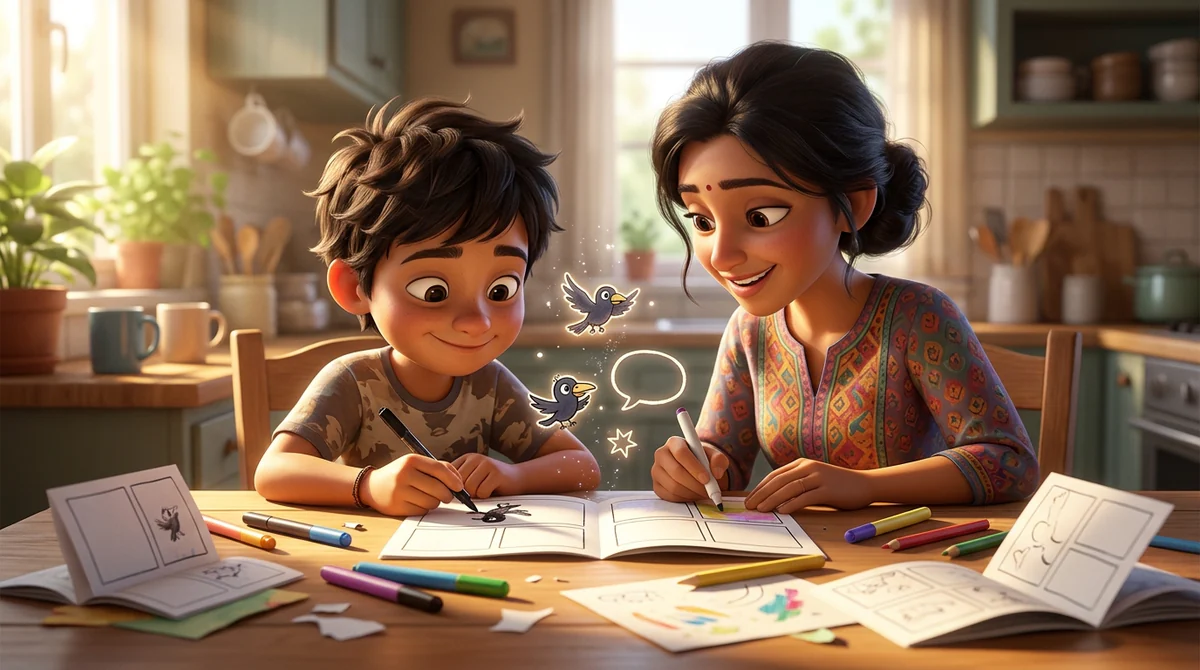
The back pages of your eight-year-old's school notebook are full of a cat in a cape. There are arrows, explosions and a lot of "KAPOW".
"Can we make a real comic? Like a proper book?"
Yes, and you don't need any special kit. A few sheets of paper folded in half, a pencil and a pen make a real comic book. Here's how to make one together, from the first idea to a stapled copy for the grandparents.
In short
- A comic is a story told in boxes, called panels, with pictures and a few words.
- Start with six panels: who and where, what they want, the problem, a try that goes wrong, a clever turn, and an ending.
- Stick figures are fine. The story matters more than the drawing.
- Keep the words short. A speech bubble holds a sentence, not a paragraph.
- Read comics together first, and look at how the artists do it.
What you need
- Two or three sheets of paper, folded in half to make a booklet
- A pencil and an eraser for planning
- A black pen for the final lines
- Colouring pencils or felt tips
- A ruler, if your child likes neat boxes (wobbly ones are fine too)
The parts of a comic page
| Part | What it is | Tip |
|---|---|---|
| Panel | One box, one moment | Six on a page is plenty to start |
| Speech bubble | What a character says | Draw the words first, then the bubble around them |
| Thought bubble | What a character thinks | A cloud shape with little circles |
| Caption | A box for the narrator: "Meanwhile..." or "The next morning" | Good for jumping in time |
| Sound effect | BANG, CRASH, SPLASH | Big letters, drawn as part of the picture |
| Gutter | The gap between panels | The reader imagines what happens there |
Comics are read left to right, top to bottom, like a page of text.
A six-panel story, step by step
- Pick a character and one thing they want. A crow who wants a mango. A robot who wants a friend. A girl who wants to win the school race.
- Panel 1: who and where. Show the character in their world.
- Panel 2: what they want. Make it clear in one picture and a few words.
- Panel 3: the problem. Something is in the way.
- Panel 4: a try that goes wrong. This is where the jokes usually are.
- Panel 5: the turn. A clever idea, a friend, a surprise.
- Panel 6: the ending. They get it, or get something better, or there's a twist.
Here's one to try:
| Panel | Picture | Words |
|---|---|---|
| 1 | A crow on a wall, looking up at a mango tree | Caption: "Kaka the crow was hungry." |
| 2 | One huge, golden mango at the very top | Kaka: "That one. That's MY mango." |
| 3 | A monkey sitting on the branch next to it | Monkey: "Mine, actually." |
| 4 | Kaka flapping hard, the monkey laughing, feathers everywhere | Sound effect: FLAP FLAP FLAP |
| 5 | Kaka whispering to a squirrel | Kaka: "Psst. I have a plan..." |
| 6 | The monkey chasing the squirrel down the tree, Kaka eating the mango | Kaka: "Teamwork!" |
Six panels is the same shape as any good story: a beginning, a problem, a turn and an ending. For more on that shape, see storytelling for kids.
When your child says "I can't draw"
- Stick figures work. Plenty of published comics use very simple characters.
- Faces do the work. Eyebrows and a mouth show almost any feeling: angry, scared, delighted.
- Draw the same character the same way each time: a hat, a stripe, a big nose. That's how readers recognise them.
- Let them write while you draw, or the other way round. A comic made by two people is still a real comic.
Cat Kid Comic Club by Dav Pilkey is about exactly this: a group of young frogs making comics, each in their own style. BookTrust gives it an interest age of 6 to 11 and a reading age of 7+. It's a lovely one to read before you start.
Keep the words short
- One or two sentences per bubble.
- Let the picture say what the words don't need to.
- Put the first speaker's bubble on the left, so the reader reads it first.
- Save the biggest letters for the loudest moment.
Making it a book
- Fold two sheets of paper in half and tuck one inside the other. That's an eight-page booklet.
- Use the front for a cover: the title, a picture and "by" with your child's name.
- Plan in pencil, then go over the lines in pen.
- Staple the fold, or sew it with a needle and thread.
- Make a copy for a grandparent, a cousin or the class.
A child who has made one comic usually wants to make a second. Let the same character come back. That's how a series starts.
Want a mentor to help with this?
- Talks through a story
- Writes their own story
- Your report on WhatsApp
Comics to learn from
Read a few together and talk about what the artist does: how big the panels are, where the words go, how they show someone moving fast.
- Cat Kid Comic Club: interest age 6 to 11, reading age 7+ (BookTrust).
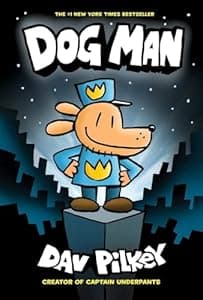
- Dog Man: funny, fast and drawn to look like a child made it. Bookstaken's catalogue suggests 6–11.
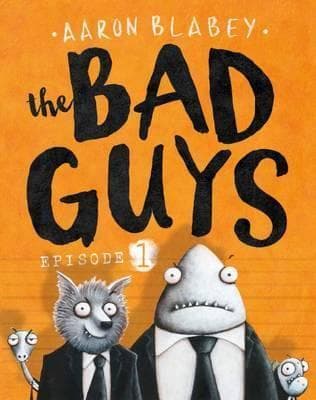
- The Bad Guys: a chapter book full of comic-style pictures. The catalogue suggests 6–8.
- El Deafo: Cece Bell's graphic memoir about growing up deaf, a 2015 Newbery Honor book. Reading Is Fundamental lists it for ages 8 to 12.
- New Kid: Jerry Craft's story of a boy who fills his sketchbook with comics. In 2020 it became the first graphic novel to win the Newbery Medal. Publishers Weekly gave it ages 8 to 12.
For more, see our graphic novels for kids and are comics good for kids?
By age
| Age | What works |
|---|---|
| 6–8 | Three- or four-panel jokes, drawing while an adult writes the words, one character with a funny problem |
| 9–11 | Six to twelve panels, a character who comes back, a booklet with a cover, comics made with a friend |
| 12–14 | Longer stories planned in rough boxes first, a series, a zine with friends, comics about real life as well as adventures |
Why it's worth the mess
Making a comic is planning a story: who it's about, what goes wrong and how it ends. It's also writing, in short, careful sentences. Children who wouldn't write a page of prose will often happily fill six panels. When they're ready for longer writing, see story writing for kids.
Stories of their own, one to one
In a Bookstaken session, your child reads a real book picked for their interests and talks it through one to one with a trained college mentor on Google Meet. Then they write a story of their own, chapter by chapter, and keep it in a digital story journal.
After every session, you get a report on WhatsApp. The first 60-minute session is free, and it includes storytelling and writing as well as talking through a story. See how it works.
Questions parents ask
How do I make a comic book with my child?
Fold two sheets of paper into a booklet. Pick a character and one thing they want, then tell the story in six panels: who and where, what they want, the problem, a try that goes wrong, a clever turn and an ending. Plan in pencil, then go over it in pen.
What are the parts of a comic?
Panels (the boxes), speech bubbles, thought bubbles, captions for the narrator, sound effects and the gutter, which is the gap between panels.
My child says they can't draw. Can they still make a comic?
Yes. Stick figures and simple faces work well, and the story matters more than the drawing. You can also split the job: one of you draws, the other writes.
What age can children make comics?
From about 6, with an adult writing the words if needed. Children of 9 to 11 can usually plan and write a six- to twelve-panel story, and older children can plan longer comics or a series.
Which comics are good examples for kids?
Cat Kid Comic Club is about children making comics, so it's a natural start; BookTrust gives it an interest age of 6 to 11. New Kid, the first graphic novel to win the Newbery Medal, suits many readers of 8 to 12.
Sources
- BookTrust. Cat Kid Comic Club: interest age 6–11, reading age 7+.
- Reading Is Fundamental. El Deafo: ages 8–12, 2015 Newbery Honor.
- Publishers Weekly. New Kid: ages 8–12.
- American Library Association. Newbery Medal winners and Honor books, 1922 to the present.
- School Library Journal (2020). Jerry Craft breaks barriers with historic 2020 Newbery win.
More guides on this topic: Focus and learning
Latest Articles
Similar Articles
Want Your Child to Experience Books More Deeply?
Bookstaken pairs kids with caring mentors who turn reading into engaging conversations, inspiring them to eventually write their own stories.
Responses
No responses yet. Be the first to share your thoughts.
Love books yourself? Get paid to read with kids as a Bookbuddy
