Story Writing for Kids: A Simple Format, With Examples by Class
The story format most schools ask for (title, beginning, problem, ending), worked examples for Classes 2 to 8, writing from an outline, and what to do when your child is stuck.
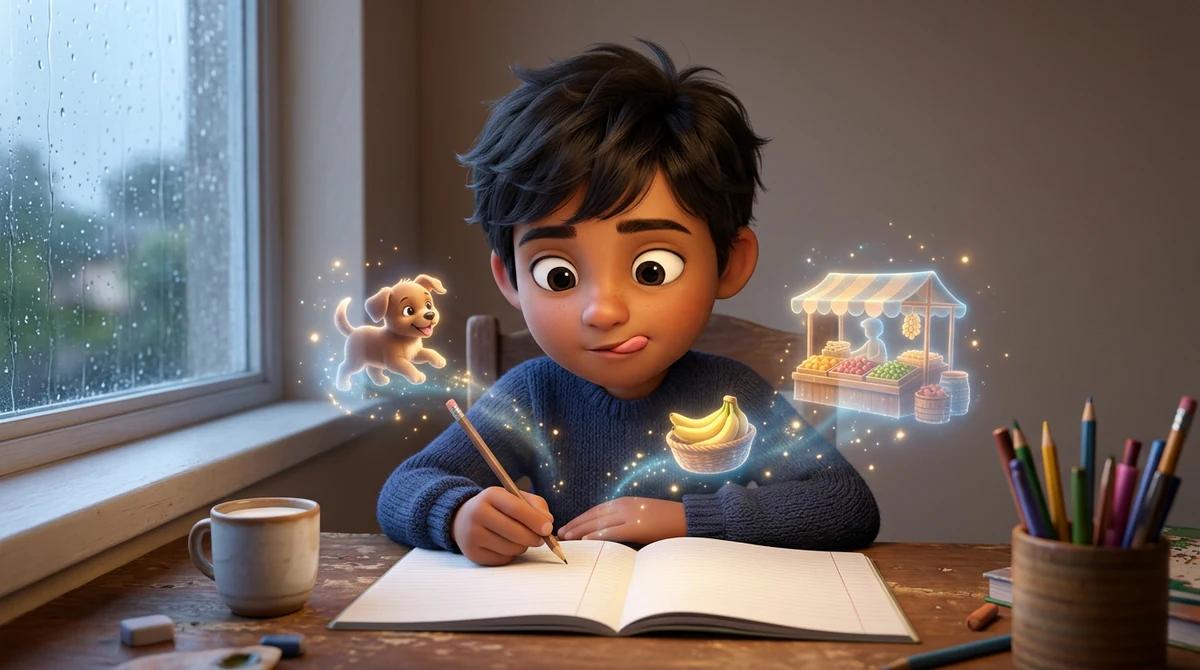
The homework says: "Write a story on 'The Lost Puppy'." There's a blank page, a pencil, and a child who has been staring at both for ten minutes.
"I don't know what to write."
Most children have plenty of ideas. What they're missing is a shape to put them in. Here's the simple format most schools look for, with examples for younger and older children, and ways to help when they're stuck.
In short
- A story has four parts: a beginning (who, where, when), a problem, what happens, and an ending where the problem is solved.
- Add a title that makes the reader curious, and a moral if your school asks for one.
- Plan before writing: four short lines, one for each part.
- Show feelings, use a little dialogue and choose words carefully.
- Check the word limit your school gives, and stick to it.
The story writing format
| Part | What goes in | Tip |
|---|---|---|
| Title | A few words that make the reader curious | "The Puppy Who Wouldn't Come Home" beats "A Story" |
| Beginning | Who the story is about, where and when | Two or three sentences. Start close to the action |
| Problem | What goes wrong, or what the character wants | This is what makes it a story |
| Middle | What the character tries, and what happens | Things can get worse before they get better |
| Ending | How the problem is solved, and how the character feels | Avoid "and then I woke up, it was a dream" |
| Moral (if asked) | One line on the lesson | Only if the question asks for it |
The same shape works for telling a story aloud. See storytelling for kids.
Plan first, in four lines
Before writing, answer four questions in a few words each:
- Who? A boy called Arjun and his puppy, Bholu.
- What goes wrong? Bholu runs off at the market.
- What happens? Arjun searches, asks a fruit seller, hears a bark.
- How does it end? Bholu is found, asleep in a basket of bananas.
Two minutes of planning saves twenty minutes of staring. For more starting points, try our story ideas generator.
Examples by class
These examples show the shape at different levels. Our examples are a guide to length, not a rule: always use the word limit your school gives.
Classes 2 and 3 (about 65 words)
The Lost Puppy Arjun had a little brown puppy called Bholu. One Sunday, they went to the market. Suddenly, Bholu pulled free and ran away! Arjun looked everywhere. He was scared and sad. Then he heard a tiny bark. Bholu was asleep in a big basket of bananas! The fruit seller laughed. Arjun hugged Bholu tight. From that day, he always held the lead with both hands.
Short sentences, a clear problem, a feeling and a happy ending. That's all this age needs.
Classes 4 and 5 (about 130 words)
The Mango Thief Every summer, the mango tree in Meera's garden was heavy with fruit. But this year, every morning, the ripest mangoes were gone. "Someone is stealing them!" said Meera. She decided to catch the thief. That night, she hid behind the water tank with a torch. Hours passed. Her eyes began to close. Then, at last, she heard a rustle in the branches. She switched on the torch. Two bright eyes stared back. It was a monkey, with a mango in each hand and one in its mouth! Meera burst out laughing. The monkey was so surprised that it dropped all three mangoes and fled. The next day, Meera tied a bell to the lowest branch. The monkey never came back, but every morning Meera checked the tree, just in case.
There's a little dialogue, a moment of suspense and a funny turn. Each part of the story gets its own short paragraph.
Classes 6 to 8 (about 230 words)
The Last Bus The clock on the bus stand said 9:52. The last bus to Kavya's village left at ten, and her phone had died an hour ago. She had stayed too long at the science fair, and now the road was dark and nearly empty. A dog barked somewhere behind the shuttered shops. At 9:58, headlights swung round the corner. Kavya let out a breath she hadn't known she was holding. But the bus didn't slow down. It roared past, its windows full of tired faces, and disappeared. For a moment she couldn't move. Then she remembered something her grandmother always said: "When you're lost, look for the light that's still on." Across the road, one shop still glowed: a tiny tea stall. An old man was wiping down the counter. "Uncle," she said, her voice shaking, "the bus didn't stop. Could I use your phone?" He looked at her for a long second, then handed it over and put a cup of tea in front of her. "Sit," he said. "Drink. Your family will come." Twenty minutes later, her father's scooter pulled up. He hugged her so hard her trophy dug into her ribs. On the way home, Kavya held on tight and watched the tea stall's light grow smaller behind them. She never found out the old man's name. But every time she passed that corner, she waved.
At this level, the writer builds tension, uses a memory to turn the story, and ends with a quiet image instead of explaining the lesson.
Writing a story from an outline
Some school exams give an outline: "A farmer — a goose — lays a golden egg every day — greedy — cuts it open — nothing inside." To turn it into a good story:
- Use every point in the outline, in order.
- Give characters names and a place.
- Add feelings: how did the farmer feel when he saw the first golden egg? When he found nothing?
- Add one or two lines of dialogue.
- Give it a title, and a moral if the question asks.
Making it better
| Instead of... | Try... |
|---|---|
| "She was scared." | "Her hands were shaking." |
| "He said." (every time) | "He whispered", "she shouted", or just let the words speak |
| "It was a very nice day." | "The sun was warm, and the mangoes were nearly ripe." |
| "And then... and then... and then..." | "Suddenly", "A few minutes later", "That night" |
| "Then I woke up. It was all a dream." | An ending where the character solves the problem |
Want a mentor to help with this?
- Talks through a story
- Writes their own story
- Your report on WhatsApp
When your child is stuck
- Talk before writing. Ask them to tell you the story out loud first.
- Start in the middle. "Bholu was gone." Then go back and add the beginning.
- Steal a shape from a book they love: a quest, a mystery, a rescue.
- Draw it first. A quick comic strip of the story works as a plan. See how to make a comic book with your child.
- Don't correct spelling while they draft. Fix it at the end.
If writing has become a battle, see my child hates writing, and for stories at home that nobody marks, try our journal prompts for kids.
Reading makes better writers
Children who read a lot pick up how stories work: how they start, how they build and how they end. See why children who read more often become better writers.
By class
| Class | What to aim for |
|---|---|
| 2–3 | A title, a beginning, one problem and a happy ending, in short sentences |
| 4–5 | Paragraphs for each part, a little dialogue, a feeling or two, a moment of suspense |
| 6–8 | Tension that builds, a turning point, varied sentences and an ending that doesn't over-explain |
Their own story, chapter by chapter
In a Bookstaken session, your child reads a real book picked for their interests and talks it through one to one with a trained college mentor on Google Meet. Then they write a story of their own, chapter by chapter, which goes into a digital story journal.
After every session, you get a report on WhatsApp. The first 60-minute session is free, and it includes storytelling and writing as well as talking through a story. See how it works.
Questions parents ask
What is the format of story writing?
A title, then a beginning that introduces who, where and when; a problem; a middle where the character tries to solve it; and an ending where it's solved. Some schools also ask for a moral at the end.
How do I teach my child story writing?
Help them plan in four lines first: who, what goes wrong, what happens and how it ends. Let them tell you the story out loud before writing, and save spelling corrections until the end.
How long should a story be for Class 4?
It depends on your school, so check the word limit in the question. Our Class 4 and 5 example is about 130 words, in short paragraphs.
What are good story writing topics for kids?
A lost pet, a mystery in the neighbourhood, a day when everything went wrong, a secret door, or a new version of a story they love. Our story ideas generator has many more.
How do I write a story from an outline?
Use every point in the outline in order, give the characters names and a setting, add feelings and a little dialogue, then finish with a title and a moral if the question asks for one.
More guides on this topic: Focus and learning
Latest Articles
Similar Articles
Want Your Child to Experience Books More Deeply?
Bookstaken pairs kids with caring mentors who turn reading into engaging conversations, inspiring them to eventually write their own stories.
Responses
No responses yet. Be the first to share your thoughts.
Love books yourself? Get paid to read with kids as a Bookbuddy
