A Bedtime Routine for Older Kids That Ends With a Book
A calm 30-minute wind-down for ages 6 to 14, with screens out and reading in, how much sleep each age needs, and what to do when bedtime turns into a battle.
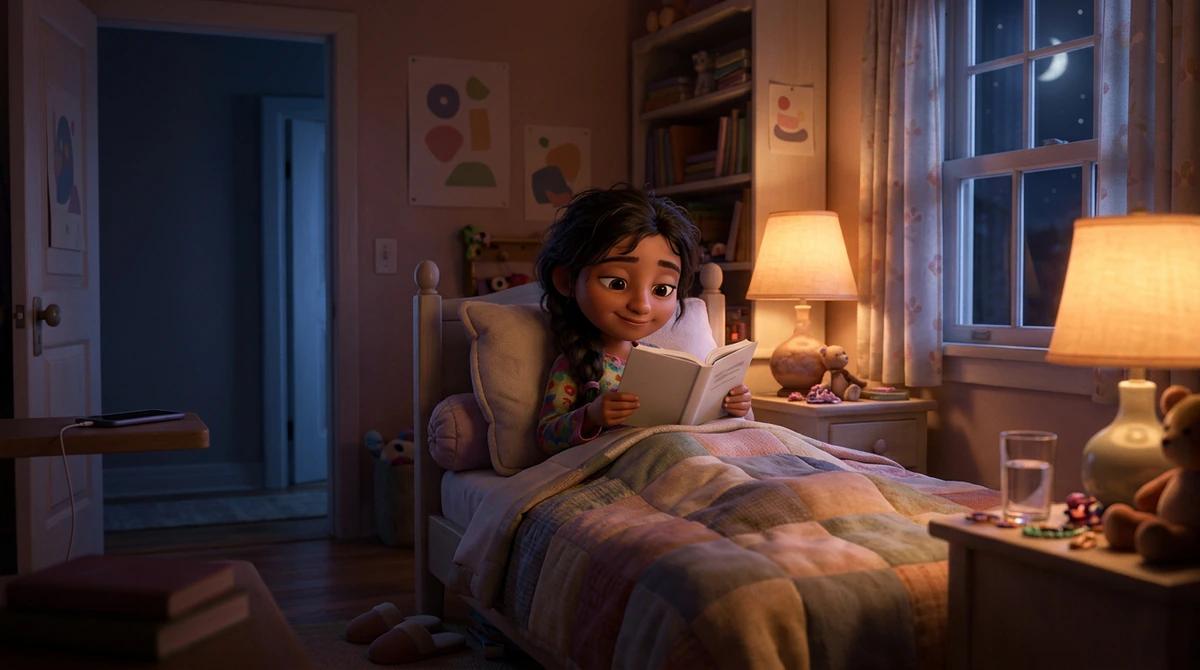
It's quarter to ten. Your ten-year-old is "just finishing" a video. Then they need a glass of water. Then the school tie has gone missing. The light finally goes off at half past ten.
Older children still need a bedtime routine. It just looks different from the bath, book and bed of the toddler years. Here's a simple one that works from 6 to 14, and ends with a book.
In short
- Children aged 6 to 12 need 9 to 12 hours of sleep; teenagers aged 13 to 18 need 8 to 10 (American Academy of Sleep Medicine).
- Screens off at least an hour before bed, and out of the bedroom at night (American Academy of Pediatrics).
- Use a 30-minute wind-down: get ready, read, talk, lights out.
- Make reading the last thing: a book in bed, every night.
- Keep the same times most nights, weekends included where you can.


How much sleep does my child need?
| Age | Recommended sleep in 24 hours |
|---|---|
| 6–12 | 9 to 12 hours |
| 13–18 | 8 to 10 hours |
These are the American Academy of Sleep Medicine's recommendations, which the American Academy of Pediatrics also shares with parents. To find a bedtime, count back from the time your child has to wake up. A nine-year-old who wakes at 6.30 am needs to be asleep by 9.30 pm for nine hours, and earlier for more.
The 30-minute wind-down
| Before lights out | What happens |
|---|---|
| 60 minutes | Screens off: phones, tablets, TV and games. Devices go to charge outside the bedroom |
| 30 minutes | Getting ready: wash, teeth, pyjamas and tomorrow's school bag packed |
| 20 minutes | Reading in bed: their own book, or a chapter read aloud for younger children |
| 5 minutes | A quiet chat: the best bit of the day, or what might happen next in the story |
| 0 | Lights out |
The hour between screens off and lights out isn't empty. It's clearing up after dinner, a shower, packing bags and getting ready. The routine just puts the calm parts last.
Why end with a book?
- It's calm. A book doesn't play the next episode on its own.
- It's a signal. The same book at the same time becomes a sign that the day is ending.
- It adds up. Twenty minutes a night is well over two hours a week. See how much a child should read every day.
- It's theirs. Choosing what to read gives children some control at a time of day when they often push for it.
Choosing a bedtime book
- Something they enjoy, not school reading or a book they're struggling with.
- Short chapters, so there's a natural place to stop.
- Funny or gentle stories for children who find it hard to settle. Try our funny books for kids or graphic novels.
- Go easy on the frights for anxious children. See are scary books good for kids?
- Paper, e-reader or tablet? See Kindle, tablet or paper book for kids.
- Audiobooks count too, played on a speaker rather than a phone in bed. See do audiobooks count as reading?
By age
| Age | What works |
|---|---|
| 6–8 | A chapter read aloud, then a few minutes with the book on their own; lights out after a story chat |
| 9–11 | Their own chapter book in bed; on some nights, you read a page or two together |
| 12–14 | An agreed screens-off time, phones charging outside the room, and reading in bed as their own time |
For read-aloud ideas, see our read-aloud chapter books, and keep going after they can read alone: how to read aloud to your child.
Make reading the part of the week they look forward to
- Talks through a story
- Writes their own story
- Your report on WhatsApp
When bedtime is a battle
| The problem | Try |
|---|---|
| "Just one more episode" | Agree the screens-off time in advance, and give a ten-minute warning |
| "I'm not tired" | Keep the routine anyway. Reading in bed is allowed; getting up isn't |
| "Just one more chapter" | Agree the stopping point before they start: the end of this chapter |
| A teenager on their phone in bed | A charging spot outside the bedrooms, for the whole family, adults included |
| Worries keep them awake | A notebook by the bed to write worries down, and a chat earlier in the evening |
If screens are the biggest fight, see how to reduce screen time without daily fights.
Weekends and holidays
Keeping weekend bedtimes and wake-up times close to school nights makes Monday mornings easier. On holidays, a later bedtime is fine; keep the book at the end of the day.
Their reading, between sessions
In a Bookstaken session, your child reads a real book picked for their interests and talks it through one to one with a trained college mentor on Google Meet. Between sessions, a short reading quest keeps the book going, and bedtime is a good time for it. Then they write a story of their own, chapter by chapter.
After every session, you get a report on WhatsApp. The first 60-minute session is free. See how it works.
Questions parents ask
What is a good bedtime routine for a 10-year-old?
Screens off at least an hour before bed, then about 30 minutes to get ready, read in bed and have a short chat before lights out. Keep the same order and roughly the same time every night.
What time should a 10-year-old go to bed?
It depends on when they wake up. The American Academy of Sleep Medicine recommends 9 to 12 hours of sleep for children aged 6 to 12, so a child who wakes at 6.30 am should be asleep by about 9.30 pm.
Is reading before bed good for kids?
It's a calm, screen-free way to end the day, and a few minutes every night builds a reading habit. Choose a book they enjoy, with chapters short enough to stop at.
Should my child read on a tablet at bedtime?
The American Academy of Pediatrics advises turning off all screens at least an hour before bed and keeping them out of children's bedrooms at night. A paper book is the simplest choice.
How long should my child read before bed?
Fifteen to twenty minutes is plenty. If they're desperate to finish the chapter, agree on that stopping point before they start.
Sources
- Paruthi, S. and colleagues (2016). Recommended amount of sleep for pediatric populations: a consensus statement of the American Academy of Sleep Medicine. Journal of Clinical Sleep Medicine, 12(6).
- American Academy of Pediatrics, HealthyChildren.org. Healthy sleep habits: how many hours does your child need?
More guides on this topic: Reading habits and confidence
Latest Articles
Similar Articles
Want Your Child to Experience Books More Deeply?
Bookstaken pairs kids with caring mentors who turn reading into engaging conversations, inspiring them to eventually write their own stories.
Responses
No responses yet. Be the first to share your thoughts.
Love books yourself? Get paid to read with kids as a Bookbuddy
