Do Reading Logs Work? What Research Says, and Better Ways to Keep Track
What a study of mandatory reading logs found, why rewards for reading can backfire, how to handle a log the school sets, and lighter ways to notice your child's reading.
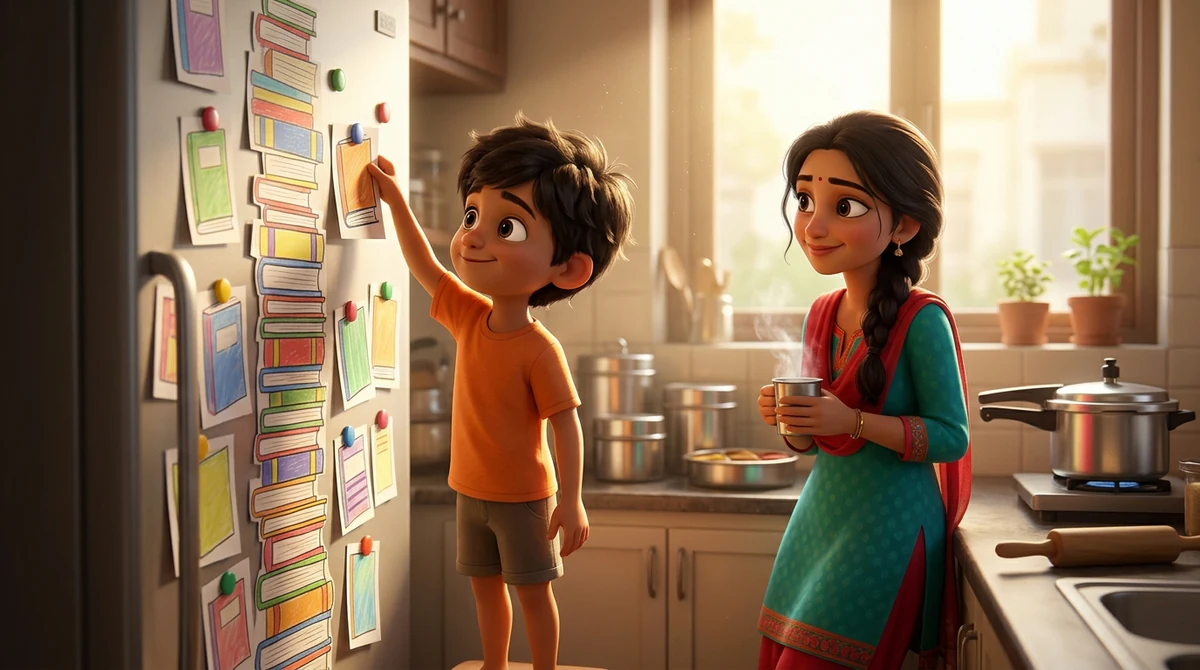
It's Sunday night, half past nine. "You have to sign my reading log!"
The log says twenty minutes a night, every night, with the page numbers. Nobody can remember what happened on Wednesday. Your child, who used to read under the covers, now watches the clock until the timer goes off.
Reading logs are meant to build a habit. Sometimes they do. But a log can also turn reading into a chore. Here's what the research says, and what to do instead, or alongside.
In short
- Mandatory logs can backfire. In a study of 112 children in grades 2 and 3, those given a mandatory log showed a fall in interest in reading for fun, compared with classmates whose log was voluntary (Pak and Weseley, 2012).
- Rewards for reading can lower motivation, especially for children. A review of 128 studies found that expected, tangible rewards reduced people's own interest in an activity (Deci and colleagues, 1999).
- A log helps most when the child owns it: recording books they chose, not minutes on a timer.
- If the school requires one, keep it light and let your child fill it in.
- Lighter ways to keep track include a book list, star ratings and talking about what they read.
What the research says
Mandatory logs. Researchers Sarah Pak and Allyson Weseley gave 112 second- and third-graders either a mandatory reading log or a voluntary one, and asked about their motivation at the start and two months later. Children with mandatory logs showed falls in their interest in, and attitudes towards, reading for pleasure, compared with those whose logs were voluntary. It's one small study, but it matches what many parents see.
Rewards. Edward Deci, Richard Koestner and Richard Ryan reviewed 128 experiments on rewards and motivation. Expected, tangible rewards (prizes, stickers, treats) tended to reduce people's own interest in the activity, and more so for children than for college students. Positive feedback, such as genuine praise, had the opposite effect: it increased interest. For more, see how to motivate children to read without rewards or punishments.
Why logs can go wrong
- Minutes become the goal, rather than the story. Children watch the clock.
- Short, easy books win, because they fill the log faster.
- Parents become the police, checking, reminding and signing.
- Reading starts to feel like homework, with a deadline.
- The log gets filled in from memory, or made up, on Sunday night.
When a log can help
Logs aren't all bad. Some children love seeing their list grow. A log tends to work when:
- your child chooses to keep it;
- it records books, not minutes;
- there's space for what they thought, not just page numbers;
- nobody is checking it for rewards or punishments.
If the school sets a log
You may not have a choice, and that's fine. A few things make it easier:
- Ask the teacher what it's for. Is it to build a habit, check reading at home, or start conversations? The answer changes how strict you need to be. See questions to ask your child's teacher about reading.
- Let your child fill it in, in their own words.
- Count all reading: comics, audiobooks, recipes, reading aloud to a younger sibling. See do audiobooks count as reading?
- Fill it in at one regular time, such as Sunday afternoon, rather than nagging nightly.
- Don't add your own rewards on top.
- Tell the teacher if the log is causing tears. Most would rather know.
Lighter ways to keep track
| Idea | How it works | Ages |
|---|---|---|
| A book list | A sheet on the fridge with every title they finish | 6–14 |
| Star ratings | One to five stars and one line: "Best bit: the dragon" | 7–14 |
| A "shelfie" | A photo of the pile of books they read this term | 6–14 |
| A reading map | Mark where each story is set on a map | 8–14 |
| A series tracker | Tick off each book in a series they love | 7–12 |
| A reading journal | A few lines on what they thought, not what they read | 9–14 |
| Talking | "What's happening in your book?" at dinner | 6–14 |
None of these needs a timer. All of them keep the focus on the books. For a year-long version, see our 2027 reading challenge for kids, and for a few lines of opinion, see how to write a book review.
Make reading the part of the week they look forward to
- Talks through a story
- Writes their own story
- Your report on WhatsApp
How much should they read?
There's no magic number. A short, regular time that your child enjoys beats a long one they dread. For suggestions by age, see how much should a child read every day?
By age
| Age | What works |
|---|---|
| 6–8 | A sticker-free book list, reading aloud counted as reading, an adult filling in the school log with the child |
| 9–11 | Star ratings and one-line reviews, a series tracker, the child filling in their own log |
| 12–14 | A reading journal or none at all, talking about books, keeping the school log brief |
Progress you can see, without a log to sign
In a Bookstaken session, your child reads a real book picked for their interests and talks it through one to one with a trained college mentor on Google Meet. Then they write a story of their own, chapter by chapter, which goes into a digital story journal.
After every session, you get a report on WhatsApp, so you can see how they're getting on without a log to sign. The first 60-minute session is free. See how it works.
Questions parents ask
Do reading logs work?
They can help a child who enjoys keeping track, but mandatory logs can backfire. In a study of 112 children in grades 2 and 3, mandatory logs led to a fall in interest in reading for fun compared with voluntary ones.
Are reading logs bad for kids?
Not always. The trouble comes when minutes become the goal, rewards are attached, or parents have to police them. Logs that record books a child chose, and what they thought, tend to work better.
How do I get my child to fill in their reading log?
Fill it in at one regular time each week, let your child write it in their own words, and count all kinds of reading. If it's causing tears, tell the teacher.
What can I use instead of a reading log?
A list of finished books on the fridge, star ratings with one line about each book, a photo of the term's pile, or simply asking about their book at dinner.
Should I reward my child for reading?
Rewards can lower a child's own interest in reading over time. A review of 128 studies found expected, tangible rewards reduced interest, more so for children, while genuine praise increased it.
Sources
- Pak, S. S. and Weseley, A. J. (2012). The effect of mandatory reading logs on children's motivation to read. Journal of Research in Education (via ERIC).
- Deci, E. L., Koestner, R. and Ryan, R. M. (1999). A meta-analytic review of experiments examining the effects of extrinsic rewards on intrinsic motivation. Psychological Bulletin, 125(6).
More guides on this topic: Reading habits and confidence
Latest Articles
Similar Articles
Want Your Child to Experience Books More Deeply?
Bookstaken pairs kids with caring mentors who turn reading into engaging conversations, inspiring them to eventually write their own stories.
Responses
No responses yet. Be the first to share your thoughts.
Love books yourself? Get paid to read with kids as a Bookbuddy
