How to Write a Book Review: A Guide for Kids, With Examples
Five questions that turn "It was good" into a review someone would want to read.
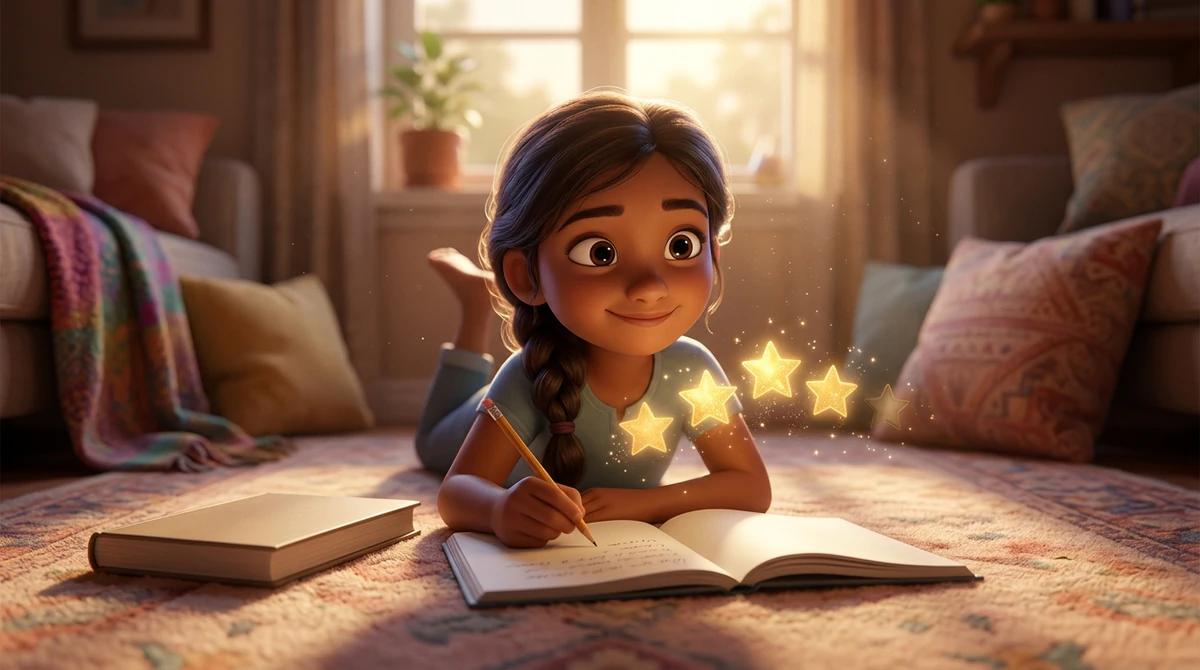
The teacher wants a book review by Friday. Your child finished the book last week and loved it. They have been sitting at the table for twenty minutes, and the page says:
"It was really good. I liked it. I would give it 5 stars."
They aren't being lazy. They have plenty to say about that book; you heard them laughing at it in bed. What they don't have is a shape to pour their thoughts into. Give them one, and the review almost writes itself.
This guide gives children a simple five-part frame, sentence starters for different ages, three sample reviews, and ideas for helping your child without writing it for them.
In short
- A book review says what you thought of a book and why, so someone else can decide whether to read it. A book report mainly retells what happens.
- Use five questions: What's it about? Who's in it? What did you think, and why? What would you change? Who should read it?
- Point to one moment in the book to back up your opinion. That one detail is what makes a review convincing.
- Never give away the ending.
- Talk it through out loud first. Children who say their review before writing it write better reviews.
Book review, book report or summary?
Teachers use these words differently, so check the task. Generally:
| What it does | Main question | |
|---|---|---|
| Summary | Retells the main events, briefly | What happened? |
| Book report | Summarises the book and its parts: characters, setting, plot | What is in this book? |
| Book review | Gives your opinion, with reasons | Is this book worth reading, and who for? |
A review can include a short summary, but the opinion is the point.
The five questions
1. What's it about?
Two or three sentences that set up the story without spoiling it. Say who the main character is, where they are and what problem they face. Stop before the big twist.
Sentence starters: "This book is about…" "When … happens, … has to…" "It is set in…"
2. Who's in it?
Introduce one or two characters and say something about them, not just their names. What do they want? What are they like?
Sentence starters: "My favourite character is … because…" "… is the kind of person who…"
3. What did you think, and why?
This is the heart of the review. Give your opinion, then prove it with one moment from the book. "It was funny" is an opinion. "It was funny, especially when the pig fell asleep in the middle of the rescue" is a review.
Sentence starters: "The best part was when… because…" "I didn't expect…" "The writer made me feel … when…"
4. What would you change?
Even a book you loved can have a slow chapter or a character you didn't believe. Saying so honestly makes readers trust the rest of your review.
Sentence starters: "The only thing I would change is…" "I wish the writer had…" "The middle was slower because…"
5. Who should read it?
Finish by helping the reader decide. Who would love this book? Who might not?
Sentence starters: "I would recommend this to anyone who likes…" "If you enjoyed …, you'll like this." "It might be too … for…"
Add a rating if you like, with a reason. "Four stars, because the ending was rushed" says more than five stars on their own.
Sentence starters by age
| Age | What to aim for | Starters that help |
|---|---|---|
| 6–8 | A few sentences: what it's about, a favourite part, a star rating | "This book is about…" "My favourite part was…" "I give it … stars because…" |
| 9–11 | A paragraph for each question, with one moment from the book as proof | "The best part was when… because…" "I would recommend this to…" |
| 12–14 | A review with a clear argument: what the book does well, where it falls short, and comparisons | "What makes this book stand out is…" "Unlike …, this book…" "It works because…, although…" |
Three sample reviews
These were written as examples, at three ages. Notice how each one gets longer and more precise, but follows the same five questions.
Age 7: Mercy Watson to the Rescue by Kate DiCamillo
Mercy Watson is a pig who lives with Mr and Mrs Watson and loves hot buttered toast. One night their bed starts to fall through the floor, and Mercy runs out of the house. My favourite part was when everyone thought Mercy went to get help, but she really just wanted toast. It made me laugh a lot. The pictures are funny too. I would change nothing, except I want more toast in it. I give it 5 stars because it is funny and short and you can read it in one go. It is good for anyone who likes animals and silly stories.
Age 10: Holes by Louis Sachar
Stanley Yelnats is sent to Camp Green Lake for a crime he didn't commit, and at the camp the boys have to dig one hole every day in the hot desert. Stanley thinks his family is cursed because of his "no-good-dirty-rotten-pig-stealing-great-great-grandfather". The best thing about Holes is that it is two stories at once. One is about Stanley at the camp, and the other is from a hundred years ago. At first I didn't see why the old story was there, but slowly the pieces start to fit, like a puzzle. When I worked out one of the connections I went back and reread a chapter to check. My favourite character is Zero, because everyone thinks he is stupid, but he is the opposite. The only thing I would change is the start, which is a bit slow. I would recommend Holes to anyone who likes mysteries or stories where everything links up at the end. I give it 4½ stars.
Age 13: Refugee by Alan Gratz
Refugee follows three children in three different times: Josef, a Jewish boy escaping Nazi Germany in the 1930s; Isabel, who leaves Cuba on a homemade raft in 1994; and Mahmoud, whose family flees the war in Syria in 2015. Their chapters take turns, and each one ends on a cliffhanger, which makes it very hard to put down. What makes the book stand out is how the three journeys echo each other. Each child has to decide when to be noticed and when to hide, and each one learns something that the others will need. Gratz never tells you what to think about refugees. He just puts you on the boat. It is not an easy read. There are deaths, and some chapters are frightening. My one criticism is that the ending ties the stories together a little too neatly, which made it feel less real than the rest. Even so, it is one of the most powerful books I have read this year. I would recommend it to anyone who liked Number the Stars, and to anyone who thinks history is boring.
You can read more about each book, including ages and content notes, in our guides to Mercy Watson to the Rescue, Holes and Refugee.
Want a mentor to help with this?
- Talks through a story
- Writes their own story
- Your report on WhatsApp
Mistakes that weaken a review
- Retelling the whole plot. Two or three sentences is enough. The reader wants to know whether to read it, not what happens on every page.
- Giving away the ending. If you must mention it, warn the reader first.
- Opinions with no reasons. "It was boring" needs "because…".
- Too many describing words. "Amazing, awesome, brilliant" says less than one specific moment.
- Forgetting the reader. Always end with who the book is for.
How to help without writing it for them
- Talk first, write second. Ask the five questions out loud and let your child answer. Most children can say far more than they can write at first, and saying it first helps them find the words.
- Write down their words, not yours. For younger children, jot down what they say and let them copy or type it. It is still their review.
- Ask for one moment. "Which bit proves that?" is the most useful question you can ask while they write.
- Read the draft as a reader, not a marker. Say what made you want to read the book. Spelling and full stops can be fixed at the end.
- Let them disagree with the crowd. A child who honestly didn't like a famous book can write a brilliant review about why.
If writing itself is the struggle, see My child hates writing and How to improve your child's writing skills at home.
Make it count
Reviews are more fun to write when somebody reads them. Your child could:
- Keep a reading journal with a short review of every book they finish.
- Send a review to a grandparent or cousin with a recommendation.
- Leave a review card inside a library book for the next reader.
- Read their review aloud and see whether it persuades a sibling to pick the book up.
How Bookstaken builds this habit
Giving a verdict is part of every Bookstaken session. Your child reads a real book picked for their interests and talks it through one to one with a trained college mentor. At the Review stop, they say what they think of the book so far and why, and the finished book goes on their shelf. Then they write their own story, chapter by chapter, and keep it in their digital story journal. After a few weeks of that, "It was good" turns into an opinion they can defend.
The first 60-minute session is free. See how our creative writing classes work.
Questions parents ask
How do you write a book review for kids, step by step?
Answer five questions: What is the book about (without spoilers)? Who are the main characters? What did you think, and which moment proves it? What would you change? Who should read it? Add a star rating with a reason.
What should a children's book review include?
The title and author, a short description of the story, the main characters, your opinion with one example from the book, anything you would change, and who you would recommend it to.
How long should a book review be for a child?
For ages 6 to 8, five or six sentences is plenty. For 9 to 11, three to five short paragraphs. For 12 to 14, about a page, with a clear opinion and examples.
What is the difference between a book report and a book review?
A book report mainly describes what is in a book: its plot, characters and setting. A book review gives your opinion of the book, with reasons, to help someone decide whether to read it.
How can I make writing a book review fun?
Let your child choose a book they feel strongly about, love or hate. Talk it through before they write, and give the review a real reader, such as a grandparent, a sibling or the next person to borrow the book.
More guides on this topic: Focus and learning
Latest Articles
Similar Articles
Want Your Child to Experience Books More Deeply?
Bookstaken pairs kids with caring mentors who turn reading into engaging conversations, inspiring them to eventually write their own stories.
Responses
No responses yet. Be the first to share your thoughts.
Love books yourself? Get paid to read with kids as a Bookbuddy
