How to Spend Quality Time With Your Child: 15-Minute Ideas
Short, daily, child-led time that fits a busy week: 30 ideas for talking, playing, making, moving and reading together, what works at each age, and how to keep phones out of it.
"Can you play with me?"
"In a minute."
The minute turns into an hour, then it's bedtime. Tomorrow, the same thing happens.
Quality time doesn't need a free afternoon. Fifteen minutes, most days, with your full attention, is a good place to start. Here's how to make it work in a busy week, and 30 ideas to begin with.
In short
- Short and regular beats long and rare. Fifteen minutes most days is a realistic goal.
- Let your child lead. They choose; you join in.
- Phones away for the fifteen minutes, yours included.
- Mix it up: talk, play, make, move and read.
- Use time you already have: the walk to school, cooking dinner, bedtime.



What makes it "quality" time
- Full attention. No phone, no laptop, no half-listening while you cook something complicated.
- Your child chooses. Even if it's the game you find boring. Especially then.
- No teaching, no correcting. This isn't homework time.
- A regular slot, if you can: "our fifteen minutes" after dinner or before bed.
- Stop while it's still fun. "Same time tomorrow?" is a good way to end.
30 ideas in 15 minutes
Talk
- Rose, thorn, bud: the best part of the day, the hard part, and something they're looking forward to.
- Would you rather: "Would you rather fly or be invisible?"
- "Tell me about...": their game, their friend, the book they're reading. See conversation starters for kids.
- A walk round the block, side by side.
- Make up a story together, one sentence each. See storytelling for kids.
- Riddles: take turns asking. See our riddles for kids.
Play
- A card game: snap, rummy or go fish.
- A board game: ludo, carrom, chess or snakes and ladders.
- Build something with blocks or bricks, to their design.
- A paper aeroplane contest down the corridor.
- Noughts and crosses or hangman on scrap paper.
- Hide a toy and give hot-and-cold clues.
Make
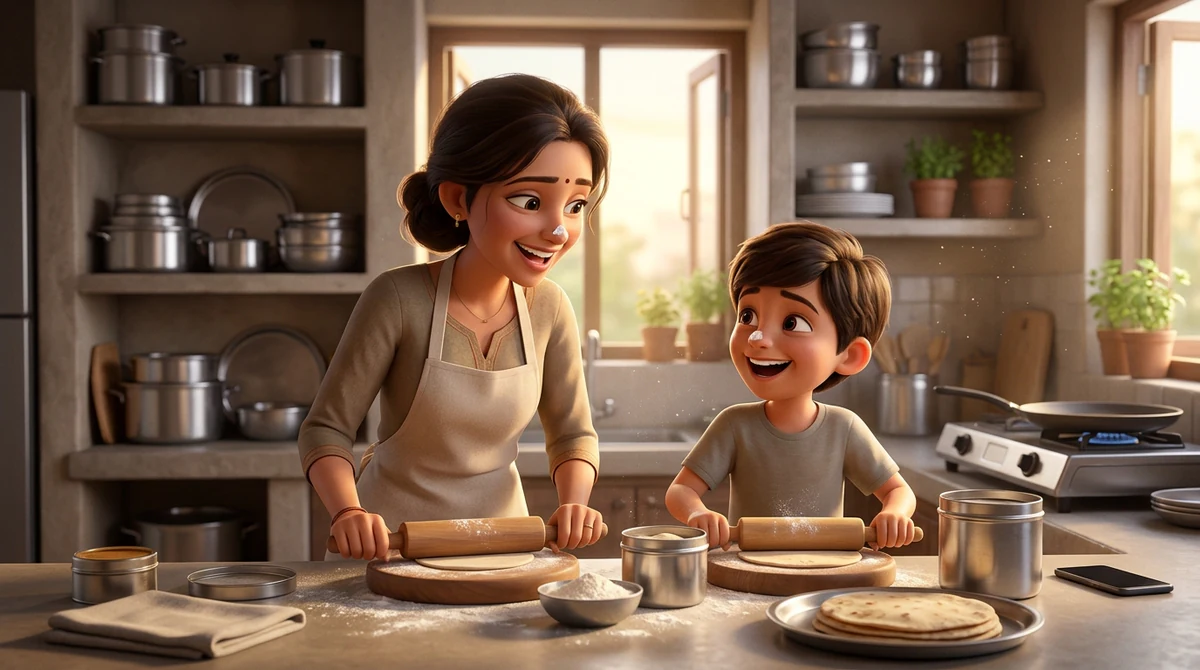
- Cook one thing together: rotis, a sandwich, a smoothie.
- Draw each other, badly, and swap.
- Make a comic strip about your day. See how to make a comic book with your child.
- Fold paper boats and race them in a bucket.
- Plant seeds and check them together each day.
- Write a letter to a grandparent or a friend who's moved away.
Move
- Dance to three songs they choose.
- Cricket, football or badminton in the park or the corridor.
- Skipping or hopscotch.
- Stretch together before bed.
- A bike or scooter ride round the block.
- A race to the end of the road and back.
Read
- Read a chapter aloud, with voices. See how to read aloud to your child.
- Swap pages: you read one, they read one.
- Let them read to you, and enjoy being the audience.
- Read a comic together and talk about the pictures.
- Read the same book separately and talk about it at dinner.
- Visit the library and let them choose.
Fitting it into a busy week
| Time you already have | What to do |
|---|---|
| The walk or drive to school | Would you rather, riddles, or an audiobook to talk about |
| Cooking dinner | Give them one job, and talk while you work |
| Bath and bedtime | A chapter aloud, and the best bit of the day |
| Weekend breakfast | A card game or a comic at the table |
| Waiting rooms | Hangman, I spy, or a story one sentence each |
For more screen-free ideas, see screen-free activities for kids.
By age
| Age | What works |
|---|---|
| 6–8 | Games with simple rules, building, reading aloud, making up stories together |
| 9–11 | Cooking, card and board games, sport, comics, reading the same series |
| 12–14 | Walks and drives where you talk side by side, cooking, their music, their games, reading the same book |
Older children often talk more when you're side by side rather than face to face: in the car, on a walk or cooking together.
A mentor who truly listens
- Talks through a story
- Writes their own story
- Your report on WhatsApp
When your child says no
- "Not now" from a twelve-year-old isn't a rejection. Offer again tomorrow, and spend time alongside them instead.
- Join their world. Ask them to teach you their game, or to show you the video they keep talking about.
- Let them pick something you find boring. That's the point.
More than one child
Try ten minutes each, one to one, on a rota, plus some time all together. Most children enjoy having you to themselves for a while.
One more person who listens
Your time with your child is irreplaceable. Some children also enjoy time with another adult who's interested in what they think.
In a Bookstaken session, your child reads a real book picked for their interests and talks it through one to one with a trained college mentor on Google Meet, then writes a story of their own, chapter by chapter. After every session, you get a report on WhatsApp, which gives you something new to ask about at dinner.
The first 60-minute session is free, and you're welcome to sit in. See how it works.
Questions parents ask
How can I spend quality time with my child every day?
Set aside fifteen minutes with your full attention, ideally at the same time each day. Let your child choose what you do, put phones away, and use time you already have, such as the walk to school or bedtime.
How much quality time does a child need?
There's no magic number. Short, regular time with your full attention matters more than long, rare outings. Fifteen minutes most days is a realistic goal for busy families.
What counts as quality time with a child?
Any time when you're fully present and your child has a say in what you do: talking, playing, cooking, reading or going for a walk together. Watching a screen together can be fun, but it leaves less room to talk.
How do I spend quality time with a teenager?
Do things side by side: drives, walks, cooking, their music or their games. Keep it low-pressure, let them choose, and keep offering even when they say no.
What if I work long hours?
Use the time you already have together, such as breakfast, the journey to school or bedtime, and make fifteen minutes at the weekend special. See raising a reader when you both work.
More guides on this topic: Feelings and friendships
Latest Articles
Similar Articles
Want Your Child to Experience Books More Deeply?
Bookstaken pairs kids with caring mentors who turn reading into engaging conversations, inspiring them to eventually write their own stories.
Responses
No responses yet. Be the first to share your thoughts.
Love books yourself? Get paid to read with kids as a Bookbuddy
